.png?w=2172&h=724)

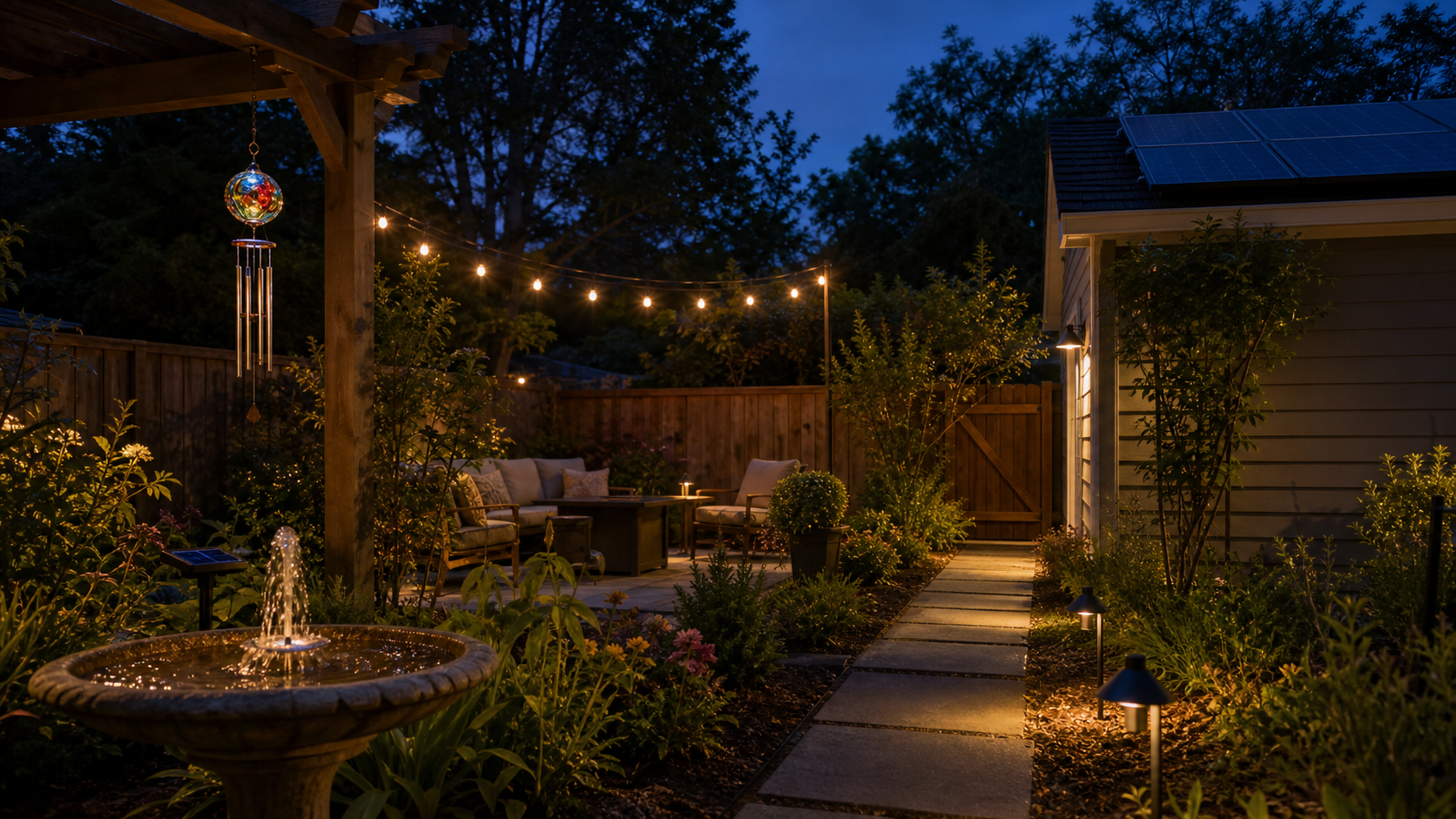
The practical answer: divide the yard into zones before buying or placing solar products. Give each zone one job—water movement, decoration, gathering light, arrival awareness or path orientation—then check whether its solar panel receives useful direct sun. A product title does not guarantee nightly runtime, waterproofing, security coverage or energy savings.
Five-zone planning table
| Zone | Example | Placement check |
|---|---|---|
| Water feature | Solar fountain | Open sun, adequate water depth, overspray clearance |
| Hanging accent | Wind chime | Secure support, sun access, neighbour awareness |
| Gathering area | String lights | Rated supports, low glare, no trip loops |
| Arrival point | Motion light | Useful detection angle without public-road triggers |
| Walkway | Path light | Downward aim, consistent spacing, mower clearance |
1. Map shade before fixtures
Observe the garden in morning, midday and late afternoon. Trees, fences, rooflines and seasonal leaf cover change the charging window. The U.S. Department of Energy explains that solar performance depends on available solar resource, orientation and shading. A panel that looks sunny during one visit may be shaded for much of another season.
Make a simple plan showing sunny charging spots, walking routes, seating, water, doors and neighbouring windows. Where the panel and light are connected by a lead, they may serve different positions; otherwise the whole unit must balance charging access with useful placement. Never extend wiring unless the manufacturer permits it.
2. Give the water zone room to move
The Solar Garden Water Fountain is a direct-sun floating fountain listing. Place it in a container wide enough for its spray pattern, with sufficient water to keep the pump operating as instructed. Wind can push spray outside a small basin and evaporation changes water level.
Check and refill water, remove debris and clean the pump according to its instructions. Do not claim continuous spray: clouds, shade, panel angle, debris and water level can change operation. Keep cords and non-submersible components away from water. A decorative fountain is not a certified aeration, mosquito-control or water-treatment system unless the exact documentation says so.
3. Hang wind chimes for sun, structure and courtesy
The Solar Globe Wind Chime combines hanging decor with a small solar light. Use a secure hook rated for the item and outdoor conditions. Keep moving parts clear of faces, doors, glass and branches. Check local rules and consider sound near bedrooms or neighbouring property.
Wipe the panel with a soft method allowed by the care instructions. Bring the product in when forecast conditions exceed its stated limits. “Outdoor” does not mean submersible or indestructible, and this guide makes no waterproof guarantee.
4. Keep gathering light warm, low and restrained
The Solar String Lights Outdoor can define a patio or pergola. Attach them only to suitable supports without piercing or crushing insulation. Keep slack controlled and routes away from doors, heaters, sharp edges and places where people can catch a loop.
DarkSky International recommends using light only where and when needed, at the lowest useful level, aimed downward and in warmer colours. Decorative light should not spill into neighbouring windows or erase the view of the night sky. Use timers or off switches when available rather than assuming dusk-to-dawn operation is necessary.
5. Treat motion lights as convenience, not security systems
The Outdoor Solar Motion Light is a sensor-light listing. Aim its detection field at the approach you control, not a public sidewalk, road or neighbour’s yard. Test it after dark from several directions and adjust sensitivity or mode only as the product allows.
A motion light can improve momentary visibility but cannot guarantee detection, deter crime or replace locks, alarms, cameras or professional safety planning. Animals, plants, heat and traffic may cause triggers; a person may approach outside the sensor’s field. Mounting into walls, masonry or elevated locations may require an appropriate professional and local-code compliance.
6. Use path lights to reveal edges, not flood the yard
The Solar Glass Brick Path Light is a landscape product for walkway use. Place lights where they clarify changes in direction or level while avoiding glare into a walker’s eyes. Consistent modest spacing is usually more useful than a few dazzling points.
Do not place units where they become mower, snow-removal or trip hazards. A decorative path light does not replace code-required illumination on stairs, exits or accessible routes. Electrical Safety Authority guidance and local codes should govern any mains-powered equipment added nearby; use qualified help when required.
7. Plan a seasonal maintenance loop
- Monthly in active season: clear leaves, pollen and soil using approved methods.
- After storms: inspect stakes, hooks, housings, cables and water intrusion without opening sealed parts.
- At season changes: reassess shade from foliage and the lower winter sun.
- Before freezing weather: follow fountain draining and storage directions.
- For batteries: use only specified replacements and recycling channels; never mix types.
NREL notes that photovoltaic output is affected by factors including irradiance, temperature and soiling. Real-world charging and runtime therefore vary. Record what each zone does over several ordinary days before adding more fixtures.
Charging and nighttime audit
- Confirm each exact variant and instruction sheet.
- Remove transport tabs and set switches as directed.
- Give panels an unobstructed trial charge.
- At night, walk every route and sit in each seating position.
- Redirect glare downward and reduce unnecessary lighting.
- Confirm fixtures do not obstruct doors, drainage or maintenance.
- Never promise a runtime, waterproof rating, security outcome or bill reduction beyond verified documentation.
Frequently asked questions
Will every solar light run all night?
No guarantee is appropriate. Runtime varies with product, battery condition, mode, season, temperature, shade, soiling and weather.
Are outdoor solar lights waterproof?
Not automatically. Check the exact documented ingress or weather-resistance instructions and installation limits. Do not submerge a product unless specifically approved.
Can a motion light secure my property?
It may provide convenient light, but it cannot guarantee detection or security. Use layered measures appropriate to the property.
Do solar lights always save energy or money?
No blanket savings claim is justified. Manufacturing, replacement, battery life, charging conditions and the grid-powered system being compared all matter.
How can I reduce light pollution?
Use fewer lights, the lowest useful output, warm colour, downward shielding, targeted placement and controls that switch lights off when unnecessary.
Bottom line
A good solar garden plan begins with zones and limits. Put the fountain in dependable sun with responsible water care, hang the chime securely, keep string lighting restrained, test the motion field and aim path lighting downward. Review the garden each season instead of treating installation as permanent.