.png?w=2172&h=724)

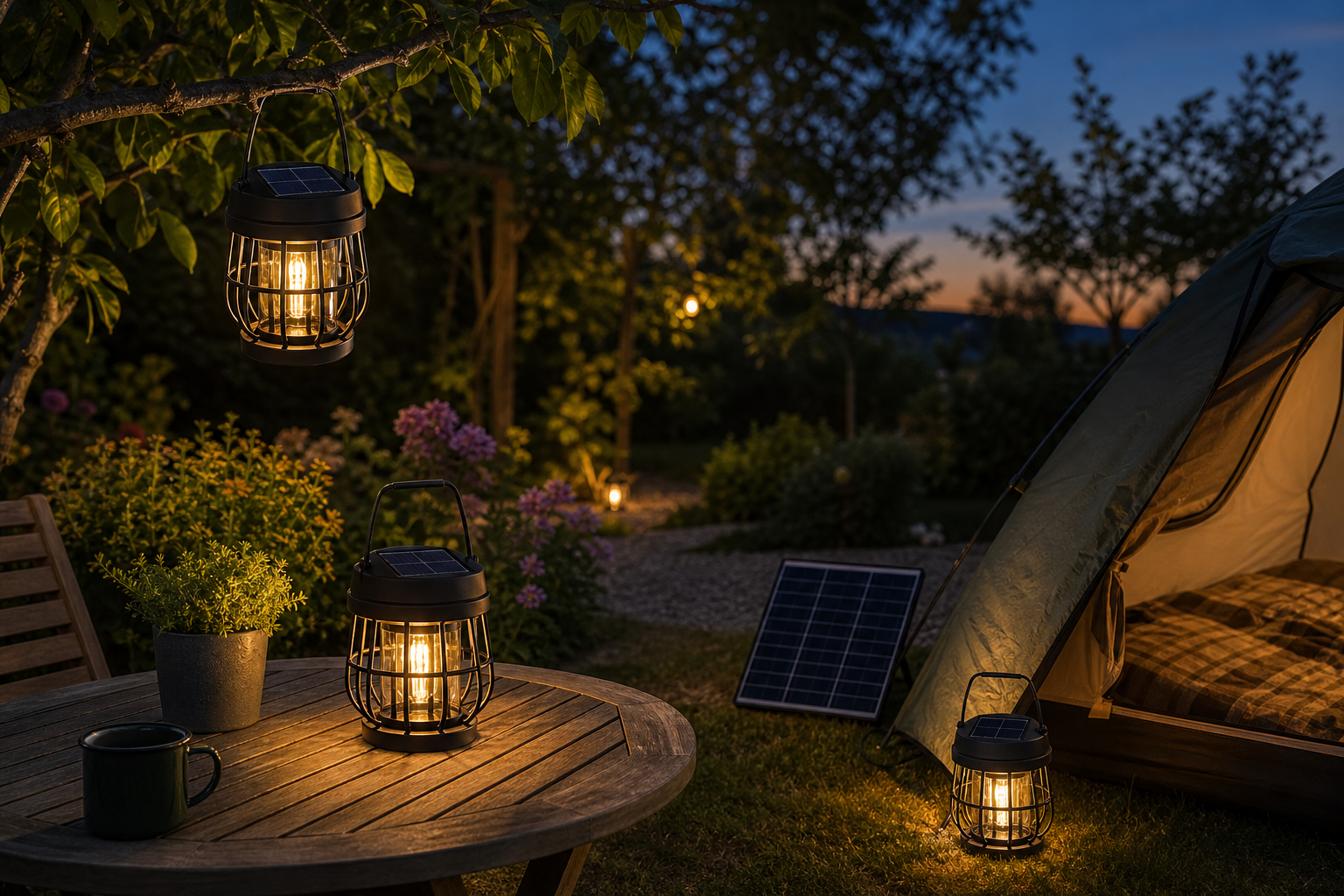
We carry four lantern styles: hanging solar hot-air-balloon lanterns, flickering-flame decorative solar lanterns, and metal hummingbird solar lanterns for patios and gardens, plus collapsible LED camping lanterns for the campsite. The solar lanterns charge in daylight and glow at dusk on their own; the camping lantern is USB or battery rechargeable, not solar.
A lantern does something a stake or string light can’t — it’s a single, movable point of warm light you can hang, set on a table, or carry along. Most lanterns here are solar and built for the garden or patio; one is a rechargeable LED made for the campsite. Here’s what we carry, where each fits, how they charge, and how to hang them.
The solar & LED lanterns we carry
There are four to know, and they split neatly into three solar decorative pieces and one rechargeable travel light.
Solar hot air balloon lantern
The solar hot air balloon lantern is the most decorative hanging piece — a balloon shape with a warm flame-style glow inside. It charges by day and lights up on its own at dusk, adding whimsy over a patio table or from a tree branch with zero wiring. Being solar, it wants a spot that sees real daylight.
Flickering flame solar lantern
The flickering flame solar lantern mimics dancing candlelight. The flame is an LED effect — no real fire, fuel, or heat — and, like our solar flame torches, it’s decorative and won’t repel insects. Reach for it when you want cozy, campfire-style ambiance on a porch or patio without an open flame.
Hummingbird solar lantern
The hummingbird solar lanterns are decorative metal lanterns with a hummingbird motif — as much garden ornament as light. Hang one from a shepherd’s hook among your plants and it earns its keep twice: as décor by day, then a soft glow after dark. Being solar, it charges and switches on by itself.
Collapsible LED camping lantern
The collapsible LED camping lanterns are the odd one out — and the most practical. They pack flat, then expand into a lantern for the tent, picnic table, or emergency kit. One honest note: these are rechargeable (USB or battery-powered), not solar, so you charge them at home before a trip rather than counting on sun at the campsite.
How do solar lanterns charge — and is the camping lantern solar?
Every solar lantern here works the same way: a small built-in panel soaks up daylight, and a dusk-to-dawn sensor switches the light on at nightfall and off in the morning. No plugs, no wiring, no outlets. The honest trade-off is that runtime follows the sun — a long summer day banks the most power, while short, cloudy, or winter days (or a panel in shade) mean noticeably fewer hours. If a lantern looks dim, the panel usually just needs a sunnier spot.
The collapsible camping lantern is the exception, and that’s the point. It recharges by USB or batteries instead of solar, so you top it up at home and it lights a tent or a rainy campsite where a solar panel would struggle. Think of the solar lanterns as set-and-forget garden décor, and the camping lantern as a portable light you charge on demand.
Which lantern fits where?
| Lantern | Power source | Best spot |
|---|---|---|
| Hot air balloon lantern | Solar | Hanging over a patio or from a branch |
| Flickering flame lantern | Solar | Porch & patio ambiance, tabletop or hook |
| Hummingbird lantern | Solar | Garden beds, on a shepherd’s hook |
| Collapsible camping lantern | USB / battery rechargeable | Campsite, tent, RV, emergency kit |
For a patio or pergola, the balloon and flickering-flame lanterns hang beautifully from beams or hooks for that warm, gathered-around glow after sunset — our best solar lights for the patio roundup covers more ways to light the space. For garden decor, the hummingbird lantern belongs among the plants on a shepherd’s hook, reading as an ornament by day. And for the campsite or tent, the collapsible camping lantern packs down small and charges before you leave — our best solar lights for RV camping guide covers what else travels well.
How to hang solar lanterns the right way
A few small habits make hanging lanterns easier — and, for the solar ones, keep them actually charging:
- Use the built-in loop or handle over an S-hook, shepherd’s hook, or pergola hook rather than bare wire that can bend the fitting.
- Keep the panel facing the sky. Tucking a solar lantern under a dense canopy or a solid patio roof looks lovely but starves the panel — hang it where it still catches direct daytime sun, or move it out to charge and back to hang.
- Hang it securely for wind. A lantern swings, so pick a sturdy hook and a spot where gusts won’t knock it loose.
- Expect a shorter glow in winter and bring the more delicate pieces indoors during harsh weather.
For hanging heights, spacing, and hook ideas that apply just as well to lanterns, our guide to hanging solar string lights is a good companion read.
Are solar lanterns a good gift?
They’re easy gifts because there’s nothing to install — no wiring, no electrician, no outlet. The hummingbird lantern suits a gardener; the hot air balloon lantern makes a charming housewarming gift; and the collapsible camping lantern is genuinely useful for campers, RVers, or an emergency kit. Each works out of the box — the solar ones just need a sunny yard or windowsill, and the camping lantern a quick USB top-up.
Solar lantern FAQ
Do solar lanterns work in winter?
Yes, but expect a shorter glow. Short, low, cloudy winter days give the panel less to work with, so a solar lantern runs fewer hours than in summer. Give it the sunniest spot you can, and bring delicate pieces indoors in harsh weather.
Are the camping lanterns solar-powered?
No. The collapsible LED camping lanterns are rechargeable by USB or batteries, not solar. That’s actually an advantage for camping — you charge them at home before a trip and they light a tent or a rainy campsite where a solar panel would struggle.
Do the flame lanterns use real fire?
No. The flickering flame is an LED effect, so there’s no real fire, fuel, or heat. Like our solar flame torches, the flickering flame lantern is decorative for ambiance and won’t repel bugs.
Where should I put a solar lantern so it charges?
Somewhere its built-in panel gets direct daytime sun. Deep shade, a dense canopy, or a solid roof overhead leaves it undercharged and dim at night. If it seems weak, move the panel to a brighter spot before assuming anything is wrong.
Can I hang solar lanterns under a covered patio?
You can, but the panel still needs to see the sky to charge. If a covered spot blocks the sun, hang the lantern where it catches some direct daylight, or move it out to charge during the day and back under cover for the evening.
More guides
Specifications are current as of publication and may change. See product pages for details.