.png?w=2172&h=724)

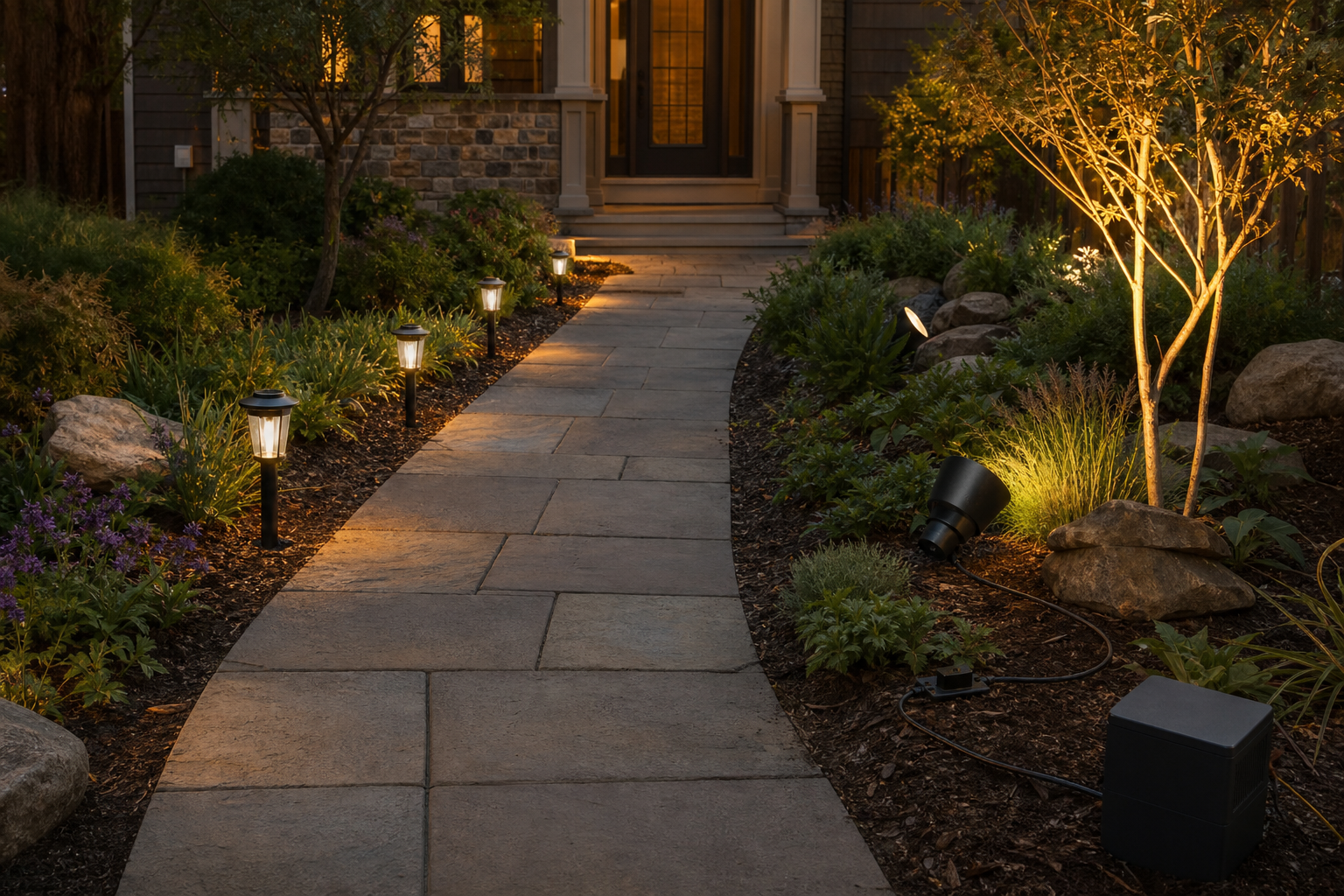
Quick answer: Choose solar landscape lighting if you want an affordable, DIY, no-wiring upgrade for accents, paths, and garden beds — it installs in minutes and costs $20–50 a fixture. Choose low-voltage (wired 12V) if you want maximum, all-weather brightness for a permanent, designed whole-yard system, and you’re prepared for a $500–3,000 professional install. Most homeowners use solar for the easy wins and low-voltage only where they need bright, guaranteed light every night.
Both light up your yard, but they work very differently and suit different goals. Here’s an honest side-by-side so you can pick the right one — and where solar (what we sell) is genuinely the smarter choice.
How each one works
Solar fixtures are self-contained: each has a small panel that charges an internal battery by day, and the light switches on automatically at dusk. No wires, no outlet. Low-voltage lights run off your home’s power through a transformer that steps 120V down to a safer 12V, with cables run underground to each fixture and a timer or switch controlling the system.
Side-by-side comparison
| Factor | Solar | Low-voltage (wired 12V) |
|---|---|---|
| Wiring | None — fully wireless | Buried cable + transformer |
| Installation | DIY in minutes, no digging | Usually a pro; trenching involved |
| Brightness | Lower (roughly 2–100 lumens), varies with sun | Higher and consistent (200+ lumens) |
| Reliability | Depends on daily sun; shorter in winter/shade | Runs every night regardless of weather |
| Upfront cost | ~$20–50 per fixture | ~$500–3,000+ installed |
| Running cost | Free (sunlight); battery every ~1–2 yrs | Small electricity cost; long-life LEDs |
| Best for | Accents, paths, beds, renters, quick upgrades | Permanent, designed, high-output yard systems |
Where solar wins
- Cost & speed: a fraction of the price, and you install it yourself the day it arrives — no electrician, no trenching.
- Renters & temporary setups: nothing is wired in, so it moves with you.
- Accents & ambiance: for path edges, garden beds, patios, and decorative glow, solar’s softer output is exactly right.
- Hard-to-wire spots: a far fence line or island bed with no nearby outlet is effortless with solar.
Browse our solar landscape lighting for path and stake lights, or see our solar flame torch guide for decorative options.
Where low-voltage wins
- Raw brightness: for bright, even uplighting on trees or a house facade, wired systems output far more light.
- All-weather consistency: no reliance on sun means the same performance every night, year-round.
- Designed systems: multiple zones, dimming, and precise control for a professionally designed look.
The trade-off is cost and installation — it’s a permanent investment, usually professionally installed.
How to decide
Ask what the lighting is for. Want to brightly and permanently light your whole property for security and curb appeal, with a budget for it? Low-voltage. Want an affordable, easy, no-wiring way to add path lights, accents, and ambiance you can set up yourself — especially if you rent or want flexibility? Solar. Many people even combine the two: wired lighting for the key features, solar for the paths, beds, and decorative touches.
Frequently asked questions
Is solar or low-voltage landscape lighting brighter?
Low-voltage is brighter and more consistent — typically 200+ lumens versus roughly 2–100 for solar, which also varies with how much sun the panels get. For soft path and accent lighting, solar’s output is usually plenty; for bright uplighting, low-voltage wins.
Which is cheaper?
Solar, by a wide margin upfront. Solar fixtures run about $20–50 each with no install cost, while a professionally installed low-voltage system runs roughly $500–3,000+. Solar’s main ongoing cost is a battery every year or two.
Is solar landscape lighting reliable?
It’s reliable as long as the panels get good daily sun. Runtime is shorter on cloudy days and in winter, and shaded yards perform worse. Low-voltage runs the same every night regardless of weather, which is its main advantage.
Can I install solar lights myself?
Yes — that’s a big reason people choose it. Solar lights have no wiring, so you simply place or stake them where they get sun. Low-voltage typically requires running cable and setting a transformer, often done by a professional.
More solar lighting guides
- Solar flame torch lights — complete guide
- Solar string lights with remote — buyer’s guide
- Solar post cap lights — do they work & what fits
Costs and specifications are general industry figures as of publication and vary by product and project. See product pages for details.