.png?w=2172&h=724)

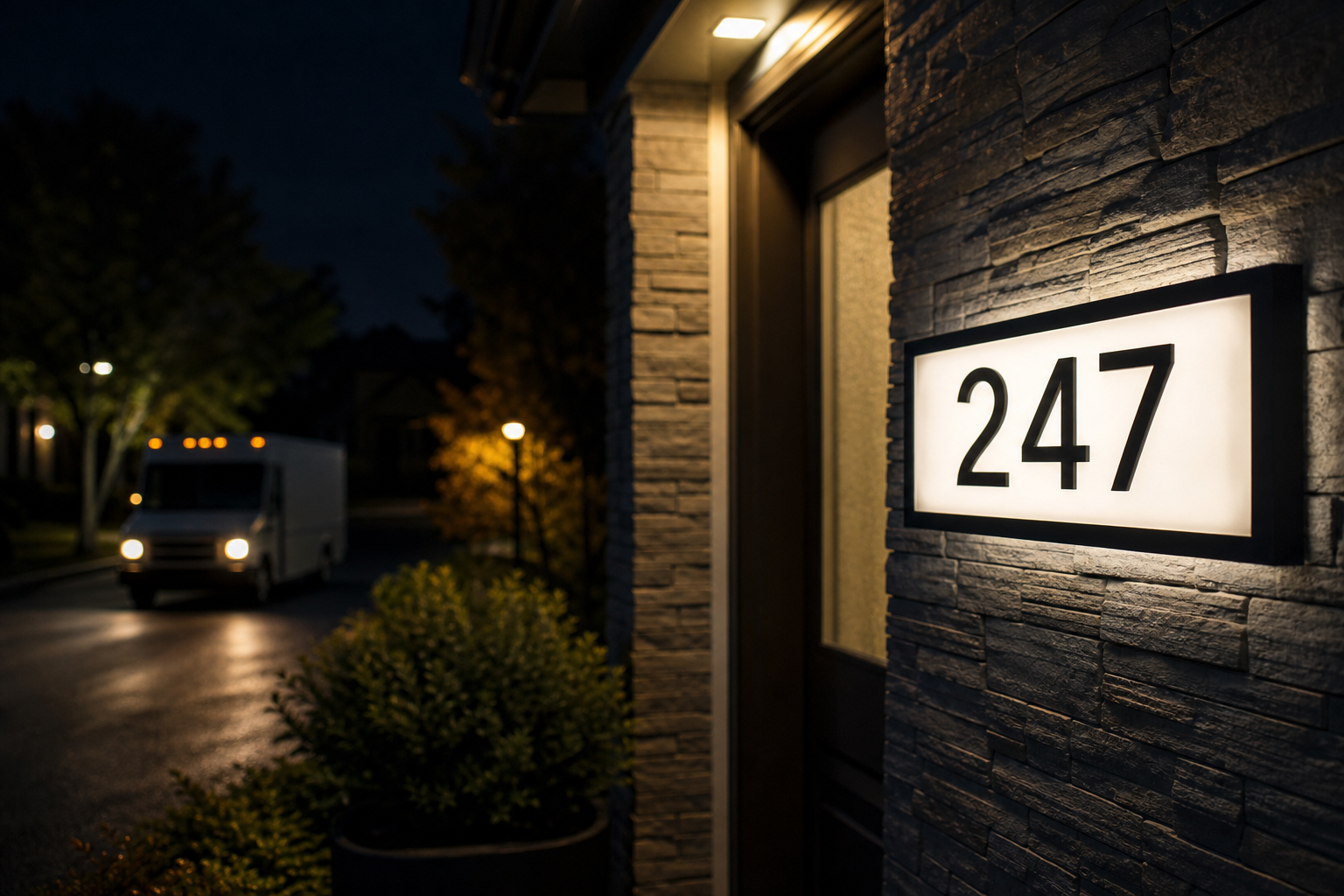
Quick answer: Clearly visible, illuminated house numbers help emergency responders, delivery drivers, and visitors find your home fast — especially at night, when an unlit address is nearly invisible from the street. Best practice is large numbers (at least 4 inches, 6 inches if you’re set back from the road), placed on the front of the house and again at the driveway or mailbox, and lit so they can be read after dark.
Most people don’t think about their house numbers until a driver circles the block or a package goes to the wrong door. This guide explains why address visibility matters more than it seems, how big and where your numbers should be, and how solar illuminated numbers solve the night-visibility problem without any wiring.
Why house numbers matter more than you’d think
When there’s an emergency, every second counts — and a hard-to-find address spends those seconds for you. A few realities worth knowing:
- Poorly marked addresses can delay emergency response by minutes. At even 30 mph, a responder has only a couple of seconds to spot a number from the street.
- GPS isn’t foolproof — it can send drivers to the wrong pin or fail in storms — which leaves your physical, visible number as the reliable locator.
- Studies note that only about half of street addresses are actually visible to a responder, often because the number faces just one direction. That’s why numbers are recommended on the front of the home and in a second spot like the driveway or mailbox.
The same visibility that helps an ambulance also gets your deliveries to the right door and your guests to the right house.
Why illuminated numbers specifically?
Plain numbers can be perfectly readable at noon and invisible at 9 p.m. Since emergencies and deliveries frequently happen after dark, the numbers need to be legible at night — and that means either a reflective, high-contrast sign or, more reliably, an illuminated one that produces its own light. Our Solar House Number Signs light up automatically at dusk with a clean backlit glow, so your address is readable from the street every night without you touching a switch — and because they’re solar, there’s no wiring to install.
How big should house numbers be?
Bigger is genuinely safer. General guidance from emergency-address recommendations:
- Use numbers at least 3–4 inches tall as a minimum.
- Homes close to the street (under ~50 feet) should use at least 4-inch numbers, with 6 inches recommended.
- Homes set well back from the road need larger numbers and a second marker down at the road or driveway entrance.
Our signs use large, clearly-sized digits designed to be read from a distance on the street or sidewalk. (Local 911 codes vary by city and county, so it’s always worth a quick check of your local requirements.)
Where should you place them?
- On the front of the house — the primary location, visible from the street.
- At the end of the driveway or on a gatepost — essential if your home is set back or not visible from the road, ideally readable from both directions of travel.
- On the mailbox or a post — a helpful second marker, with numbers roughly 4–6 feet off the ground so they sit in a driver’s line of sight.
Aim for a spot that is both highly visible from the road and gets good direct daylight, so a solar sign charges fully while doing its job.
Why solar illuminated numbers are an easy win
They combine the two things that matter — visibility and night legibility — with almost no effort:
- No wiring: each unit charges itself in the sun and lights automatically at dusk, so there’s no electrician and no trenching.
- Automatic: a dusk-to-dawn sensor turns the numbers on at night and off in the morning.
- Weather-ready: weather-resistant housing handles rain and temperature swings year-round.
- Build any address: each unit is a single character (0–9 plus A–F), so you buy one per digit and space them exactly how you like on a wall, fence, or gatepost.
| Recommended size | 4″+ numbers (6″ if set back from the road) |
|---|---|
| Key placements | House front + driveway/mailbox, ~4–6 ft high |
| Night legibility | Illuminated or reflective high-contrast |
| Our signs | Solar, auto dusk-to-dawn, ~9 hrs, one digit per unit (0–9, A–F) |
Frequently asked questions
Why do lighted house numbers matter?
They help emergency responders, delivery drivers, and visitors find your home quickly — especially at night, when unlit numbers are nearly invisible. Hard-to-find addresses can delay emergency response, and GPS can fail or misdirect, so a clear, lit number is the reliable locator.
How big should my house numbers be?
At least 3–4 inches tall as a minimum. Homes close to the street should use 4-inch numbers (6 inches recommended), and homes set well back from the road need larger numbers plus a marker at the driveway. Local 911 codes vary, so check your city or county rules.
Where should I put house numbers?
On the front of the house and again at the driveway entrance or mailbox — roughly 4–6 feet off the ground so they’re in a driver’s sight line, and readable from both directions. Choose a spot that’s visible from the road and gets direct sun to charge a solar sign.
Are solar house numbers bright enough to read at night?
Yes. They use large, clearly-sized digits with an illuminated backlight that switches on automatically at dusk, so your address reads clearly from the street after dark without any wiring.
How do I display my full address with these?
Each unit is a single character, available 0–9 plus A–F. You buy one unit per digit — for example three units for “128” — and space them however you like on a wall, fence, or gatepost.
More solar & lighting guides
- Solar house number signs — how they work
- Solar post cap lights — do they work & what fits
- Solar flame torch lights — complete guide
Local address and 911 signage requirements vary by city and county — check your local rules. Prices and specifications are current as of publication and may change.