.png?w=2172&h=724)

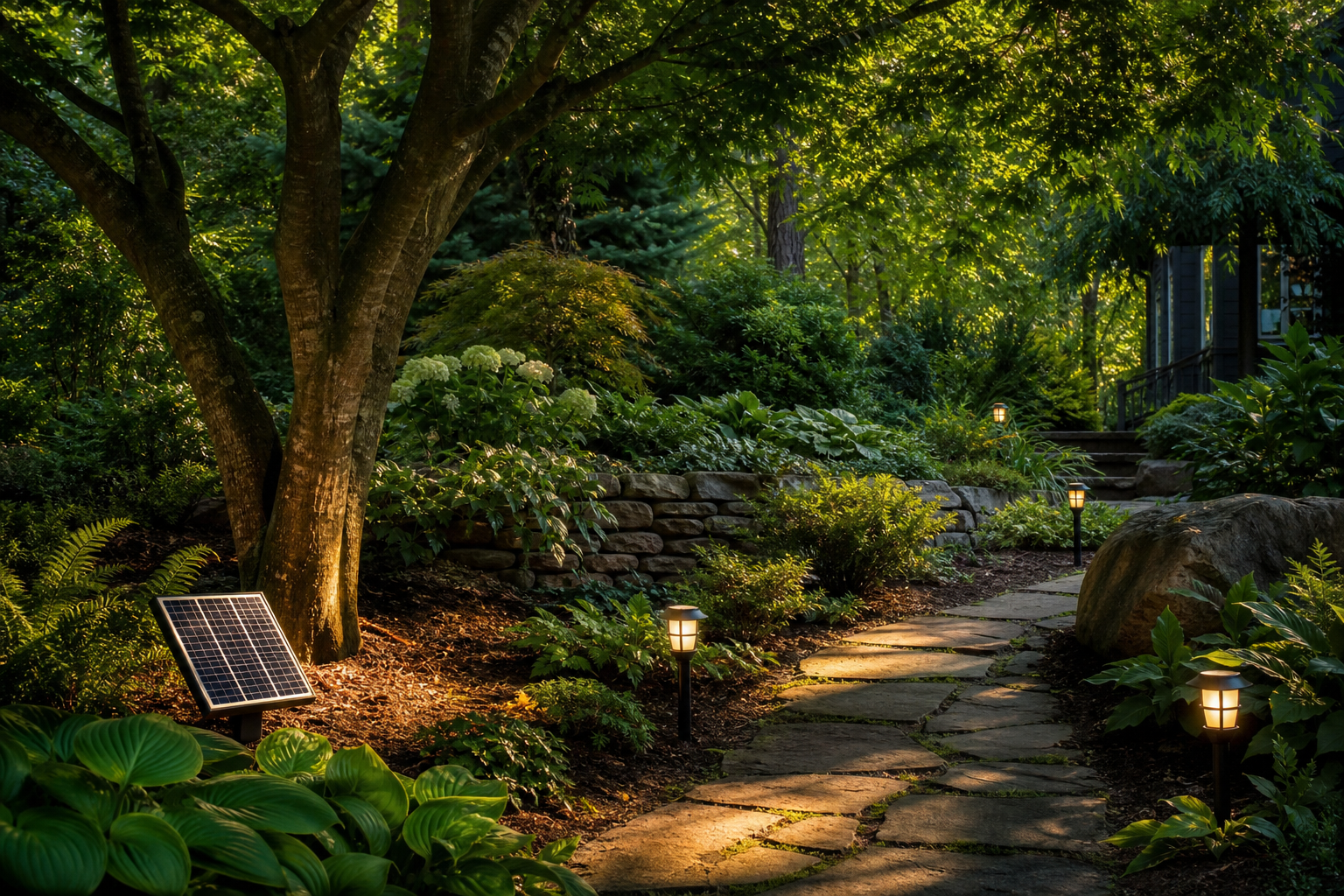
Solar lights need sunlight, so a shady yard is the toughest case — but one fix changes everything: put the solar panel in the sunniest spot you have, even when the light itself sits in shade. Then pick efficient, adjustable, and motion-triggered models that stretch a smaller daily charge across the night.
A shaded yard doesn’t rule out solar — it just means being smarter about where the panel charges and which lights you buy. A panel turns daylight into battery power, so less sun means a shorter, dimmer run each night, and even less in winter. But almost every yard has one sunny patch, and the best low-sun lights let you charge there while shining somewhere shadier.
Why shade is hard — and the one fix that helps
Solar lights are only as bright and long-lasting as the charge their panel collects by day. Deep shade from trees, fences, or the house cuts that charge sharply, and the effect is worse in the weak, low sun of winter. For the full picture, see our guide on whether solar lights need direct sunlight.
The fix is to stop treating the panel and the light as one fixed unit. Many solar lights — string lights, spotlights, and wall lights especially — have a panel that stakes or mounts separately from the bulb. So you can plant the panel in your sunniest border or on a south-facing wall, then run the light where you actually want it: under a pergola, along a shaded path, or beside a dim doorway. Pair that with a model you can dim, or one that only lights on motion, and a modest charge goes much further.
The 5 best solar lights for a shady yard
1. Solar String Lights with Remote — best for shaded patios & pergolas
These solar string lights with a remote keep the 4W panel on a separate stake, so it can sit in the sun while the Edison-style bulbs hang over a shaded patio or pergola. The remote offers three brightness levels (soft, bright, extra), so on cloudy days you can drop to soft and stretch the charge. A dusk-to-dawn sensor handles on and off, and the shatter-resistant bulbs come in 27, 48, or 104 ft runs. Runtime reaches up to 10 hours on a full summer charge — less in winter.
2. Wireless Solar Motion Sensor Lights — most efficient for shade
Because these wireless solar motion sensor lights only light up when they detect movement, they barely sip from the battery — exactly what you want when the daily charge is small. Instead of running all night, they wait, then flood the area when someone approaches, so even a partial charge covers plenty of triggers. They’re IP65-rated and fully wireless, with no outlet or wiring. Aim the built-in panel at your brightest patch of sky.
3. Solar Yard Lights with Adjustable Brightness — best for stretching a small charge
When sun is limited, being able to turn the brightness down is a real advantage. Dialing these adjustable-brightness solar yard lights to a lower setting draws less power, so a shorter charge can still cover the whole evening instead of quitting at midnight. Run them brighter on sunny days and dimmer through a cloudy stretch.
4. Solar Waterproof Spotlights — best for lighting a shaded feature
Spotlights are usually built so the head and panel can be positioned apart, which makes them ideal for shade: aim the panel at open sky and point the brighter beam at a tree, wall, or sign in the shadows. These solar waterproof spotlights are brighter than decorative stake lights — the pick when you need real punch on a focal point, not a soft glow.
5. Solar Motion Security Light — best for a dim entry or side yard
For a shaded doorway, driveway edge, or narrow side yard, this outdoor solar motion light gives security-grade brightness only when it’s needed. Like the sensor lights above, its on-demand behavior is what makes it work on a limited charge. It installs without wiring, so you can place it wherever sensor coverage matters most.
Quick comparison
| Light | Best for | Shade advantage |
|---|---|---|
| String lights with remote | Patios & pergolas | Separate panel + 3 dimming levels |
| Motion sensor lights | Walls & fences | Only runs when triggered |
| Adjustable yard lights | Paths & beds | Dim to stretch a small charge |
| Waterproof spotlights | Trees, walls, signs | Panel aims at sun, beam at shade |
| Motion security light | Entries & side yards | On-demand, minimal drain |
Low-sun setup tips to get more runtime
- Chase the sun: stake or mount the panel where it gets the most midday hours, ideally facing south with nothing overhanging it.
- Keep the panel clean: dust, pollen, and grime block charging — a quick wipe helps. More in how to charge solar lights.
- Use motion or dim modes: running lower, or only on demand, spreads a small charge across the whole night.
- Mind the season: expect shorter runtimes in winter and after cloudy days — more in how to make solar lights last longer.
When to skip solar and go plug-in
Be honest about the spot. If an area gets almost no direct sun — a north-facing wall boxed in by fences, or dense evergreen shade all day — even the best solar light will struggle, and a plug-in or low-voltage fixture will simply perform better. Use solar where the panel can catch at least a few hours of sun; use wired where it truly can’t. There’s no shame in mixing both across one yard.
Frequently asked questions
Can solar lights work in a shady yard at all?
Yes, but with less brightness and shorter runtime than in full sun. The trick is placing the panel where it can catch sun even if the light shines in shade, and choosing efficient or dimmable models. In deep, all-day shade, a plug-in light is more reliable.
Where should I put the solar panel in a shady garden?
In the sunniest spot available — often a south-facing wall, an open border, or the top of a post — with nothing overhanging it. Many string lights, spotlights, and wall lights have a separate panel, so it can charge in the sun while the light sits in shade.
Do motion-sensor solar lights last longer on low sun?
Generally yes. Because they only switch on when they detect movement, they use far less stored power than a light that runs all night, so a smaller daily charge still covers plenty of activations. That makes them a strong choice for shaded areas.
Why are my solar lights dimmer in winter?
Winter days are shorter and the sun is weaker and lower, so panels collect less energy — that means dimmer light and fewer hours. Cloudy stretches do the same. Keeping the panel clean and angled toward the sun helps recover some charge.
Is it better to buy solar with a separate panel for shade?
For a shady yard, yes — a separate (remote) panel lets you charge in the sun and light in the shade, the single biggest advantage in low sun. Fixed all-in-one lights only work well where the light itself gets direct sun.
More guides
- Do solar lights need direct sunlight?
- How to charge solar lights
- How to make solar lights last longer
Specifications are current as of publication and may change. See product pages for details.