.png?w=2172&h=724)

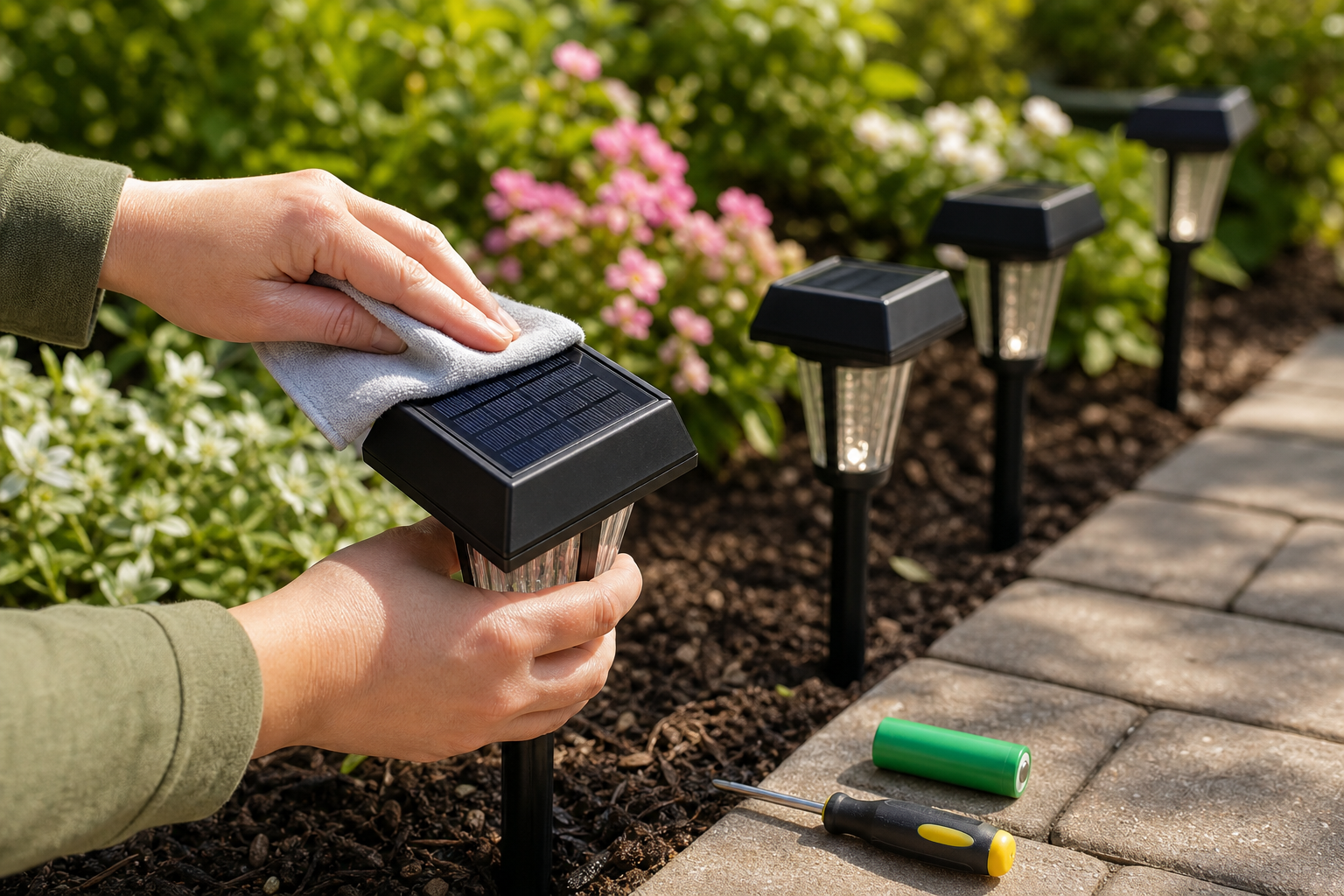
Quick answer: To make solar lights last longer and shine brighter, keep the panel clean, aim it at direct midday sun, and protect the battery. Wipe the panel every few weeks, keep it away from porch or street lights that fool the dusk sensor, give it a partial charge before winter storage, and plan to replace the rechargeable battery every 1–2 years.
Solar lights are refreshingly low-maintenance — they charge by day and switch on at dusk, with no wiring or outlets. But when one goes dim, flickers, or quits early, the cause is almost always charging or the battery, not a broken light. A few simple habits keep yours bright for years, in order of impact below.
Keep the panel clean — it’s the single biggest factor
The solar panel is the engine of the whole light, and a dirty panel is the top reason solar lights fade. Dust, pollen, hard-water spots, or bird droppings block sunlight before it reaches the cells, so the battery only partly charges and the light runs dim and short.
Wipe the panel every two to four weeks — more often in pollen season or dusty, coastal spots — with a damp cloth, or mild soapy water for stuck-on grime, then dry it (abrasive pads can haze the coating). If your lights suddenly dimmed, clean the panel before assuming anything is broken; our solar lights troubleshooting guide starts there for good reason.
Do solar lights need direct sun? Yes — place the panel accordingly
Solar panels need direct sunlight, not just daylight. Shade from a fence, eave, or tree canopy — and long stretches of cloud — cut the charge. Aim for at least six hours of direct sun a day, favoring strong midday light, and tilt the panel south where you can.
Lights with the panel on a separate wire, like our solar string lights with remote, make this easy: hang the bulbs in shade and set only the panel in the sun. Sun-dependence is a feature, not a fault — our solar water fountain runs off its panel with no battery, so it pauses under clouds and restarts in sun. For more, see how to charge solar lights and whether solar lights need direct sunlight.
Why won’t my solar lights turn on? Check for nearby light
Almost every solar light uses a dusk-to-dawn sensor: on in darkness, off in light. If a porch light, streetlight, or floodlight shines onto the panel at night, the sensor reads it as daytime — so the light never comes on, or flickers as passing headlights trip it.
The fix is placement: move the panel out of the artificial light’s path, or add a small shield so only the sky reaches it. Check this before blaming the battery — a fully charged light under a streetlight still looks dead. The same aiming helps motion models like our wireless solar motion sensor lights point their detection where you want it.
Winter and off-season storage: protect the battery
Be honest about the seasons: solar lights run shorter in winter, when days are short and the low sun is weak. Our solar flame torch lights run up to about 12 hours on a summer charge but closer to 5 in winter — expected, not a defect. Keep panels clear of snow and leaves so they charge on every bright hour.
Storing lights for the off-season? Don’t leave them dead. Give the battery a partial charge, switch the light off, and keep it cool, dry, and indoors — a cell left fully drained for months may never recover. Weather-rated lights can often stay out year-round, but anything not built for hard freezes is better off inside until spring; see the best solar lights for winter for models that tough it out.
The battery is the wear part — expect to replace it every 1–2 years
Here’s the honest truth about longevity: a solar light’s LEDs are solid-state and last for years, but the rechargeable battery is a consumable. After roughly one to two years of daily charging, its capacity drops — a light that once glowed all night now fades after an hour or two, even with a clean panel in full sun.
When you see that, the battery is the fix, not the whole light. Many solar lights use a standard replaceable rechargeable cell costing a few dollars, so check whether yours opens up (some are sealed). If it does, use the same size and a rechargeable chemistry — never ordinary alkalines, which can leak. One small swap brings a tired light back to life.
Choose weather-rated (IP-rated) models from the start
The easiest way to make a light last is to buy one built for your weather. That’s what the IP (Ingress Protection) rating tells you: the first digit is dust protection, the second is water — higher is tougher. A sealed housing keeps moisture off the battery and electronics, which is what fails first on cheap, unrated lights.
| IP rating | What it means | Best for |
|---|---|---|
| IP65 | Dust-tight; resists water jets from any direction | Walls, fences, and posts — like our IP65 solar motion sensor lights |
| IP67 | Dust-tight; withstands temporary immersion in water | Ground stakes and low spots — like our IP67 solar flame torches in heavy rain or sprinkler spray |
For ground level, garden beds, or near sprinklers, lean toward IP67; for wall- or fence-mounted lights clear of standing water, IP65 is plenty.
Your quick maintenance checklist
- Every few weeks: wipe the panel clean and dry it.
- At install: point the panel at direct midday sun, away from artificial light.
- Seasonally: clear snow and leaves; expect shorter winter runtime.
- Before storage: partial-charge, switch off, keep indoors and dry.
- Every 1–2 years: replace the rechargeable battery if runtime keeps dropping.
- When buying: choose an IP65 or IP67 model for your location.
Frequently asked questions
Why are my solar lights getting dimmer?
The two usual causes are a dirty panel and an aging battery. Clean the panel first; if a clean panel in full sun still gives short runtime, the rechargeable battery has worn out and needs replacing.
How often should I clean the solar panel?
Every two to four weeks, and more often in pollen season or dusty, coastal areas. Use a damp cloth or a little mild soapy water, then dry it, and avoid abrasive pads that can haze the coating.
Do solar lights need direct sunlight, or is shade okay?
They need direct sun — aim for at least six hours a day, ideally strong midday sun, since shade and heavy cloud sharply cut the charge. With separate-panel lights, the bulbs can sit in shade as long as the panel is in full sun.
Why won’t my solar lights turn on at night?
Often a nearby porch light, streetlight, or floodlight is shining on the panel and fooling the dusk-to-dawn sensor into reading daytime. Move or shield the panel so only the sky reaches it; a dirty panel or worn battery can also keep it off.
How long do solar light batteries last?
Usually about one to two years of daily use before capacity noticeably drops. When a clean panel in full sun still leaves a short runtime, replace the rechargeable cell — same size, rechargeable type, never standard alkaline.
More guides
- Why are my solar lights not working? Troubleshooting guide
- How to charge solar lights (including cloudy days)
- Do solar lights need direct sunlight?
Specifications are current as of publication and may change. See product pages for details.