.png?w=2172&h=724)

Reviewed and updated July 18, 2026 by the Solar Outdoor Light Deals Editorial Team.
Quick answer
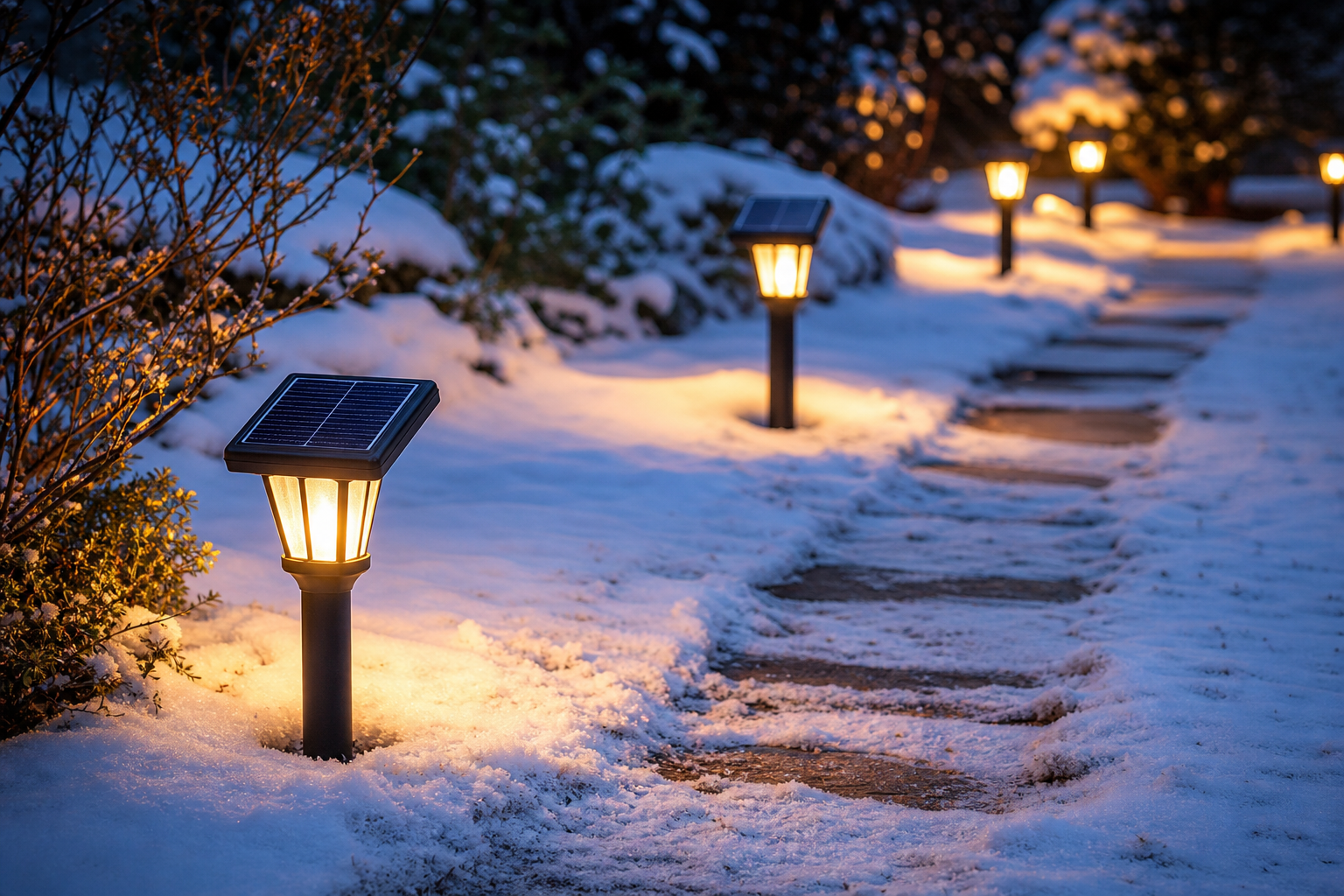
Solar lights can work in winter, but shorter days, lower sun angles, snow cover, shade, cold batteries, and longer nights can reduce available runtime. Winter performance improves when panels face the clearest sky, remain clean and uncovered, and the selected light has enough battery capacity for the intended schedule.
| Winter factor | Effect | Practical response |
|---|---|---|
| Shorter daylight | Less charging time | Prioritize open-sky placement |
| Low sun angle | Less energy on a poorly aimed panel | Adjust panel angle if supported |
| Snow or debris | Blocks incoming light | Clear panel without scratching it |
| Long nights | Battery must power more hours | Use lower-output mode when available |
Evidence note: This guide does not claim laboratory or firsthand test results. Product-specific specifications should be confirmed on the product page.
Quick answer: Solar lights do work in winter — they just run for fewer hours, because short, weak winter days give the panels less to charge with. The trick is to pick waterproof, weather-rated lights (IP65–IP67), place the panels where they catch direct midday sun, and keep them clear of snow. Durable options like IP67 flame torches, waterproof spotlights, and rated motion lights hold up best through the cold months.
Let’s be honest up front: every solar light gives you less runtime in winter than in summer — that’s physics, not a defect. But the right lights and placement keep your yard lit through the season. Here are the best picks.
1. IP67 solar flame torches — built for all seasons
Our solar flame torches are IP67 waterproof and rated for year-round outdoor use, running up to 12 hours in summer and around 5 in winter. They shrug off rain and snow while adding a warm glow to dark winter evenings.
2. Waterproof solar spotlights — for brighter accents
Waterproof solar spotlights put out more light than decorative fixtures, so even with shorter winter runtime you get useful brightness on a path, wall, or feature.
3. Rated solar motion security lights — efficient in winter
A solar motion sensor light (look for IP65) is smart for winter: because it only lights when triggered, it stretches a smaller winter charge much further than a light that burns all night.
4. Solar post cap lights — weatherproof edges
Solar post cap lights are built for outdoor exposure and keep marking your fence or deck edges through the cold — just brush any snow off the panels.
5. Weather-tolerant solar string lights — winter ambiance
Solar string lights are rated for year-round outdoor use and are perfect for holiday and winter-evening ambiance, with a remote so you can dial brightness down to stretch runtime.
Winter care tips (get the most runtime)
- Chase the midday sun: place panels where they get the strongest direct light in the short winter window — south-facing and unshaded is best.
- Keep panels clear: wipe off snow, frost, and leaves — a covered panel barely charges.
- Expect shorter hours: plan for reduced runtime, and use motion lights where you want reliability.
- Store the delicate ones: for anything not rated for harsh winters, bring it in and keep the battery partially charged.
For step-by-step fixes if a light underperforms, see our solar light troubleshooting & winter care guide.
Frequently asked questions
Do solar lights work in winter?
Yes, but for fewer hours. Short, weak winter daylight gives the panels less time to charge, so runtime drops compared with summer. Placing panels in direct midday sun and keeping them clear of snow helps a lot.
What are the best solar lights for cold weather?
Waterproof, weather-rated fixtures (IP65–IP67) like solar flame torches, waterproof spotlights, rated motion lights, and post cap lights. Motion lights are especially efficient in winter because they only run when triggered.
Can I leave solar lights out in the snow?
Weather-rated ones (IP65–IP67), yes — just brush snow off the panels so they can charge. For lights not rated for harsh winters, it’s best to bring them indoors with a partial charge.
More guides
- Solar light troubleshooting & winter care
- Do solar flame torches really work in winter?
- Why solar lights are best for Christmas
Specifications are current as of publication and may change. See product pages for details.
Sources and editorial methodology
- U.S. Department of Energy: Solar Radiation Basics
- U.S. Department of Energy: PV Performance and Efficiency Basics
- U.S. Department of Energy: Solar Energy and Storage Basics
Editorial policy: This guide distinguishes established technical principles and documented specifications from firsthand testing. Product-specific performance depends on the item and real installation conditions.