.png?w=2172&h=724)

Reviewed and updated July 18, 2026 by the Solar Outdoor Light Deals Editorial Team.
How do solar lights work?
Solar lights convert daylight into electricity, store that energy in a rechargeable battery, and use a light sensor to switch the LED on after dark. The solar cell, charge controller, battery, LED, and dusk-to-dawn sensor work as one small off-grid lighting system. Runtime changes with sunlight, panel angle, shade, season, temperature, battery condition, and the light's power setting.
| Part | What it does | Common problem |
|---|---|---|
| Photovoltaic cell | Converts light into DC electricity | Shade, dirt, or poor angle reduces charging |
| Rechargeable battery | Stores daytime energy for night use | Capacity declines with age and temperature |
| Controller and sensor | Manages charging and dusk-to-dawn switching | Nearby light can prevent activation |
| LED | Produces light from stored energy | Higher output usually consumes energy faster |
Evidence note: This guide explains established photovoltaic and battery principles. Runtime depends on the specific product and conditions; we do not present estimates as laboratory test results.
Quick answer: Solar lights work by converting sunlight into electricity. During the day, a small solar panel charges a built-in rechargeable battery. At dusk, an automatic light sensor switches on an energy-efficient LED, which runs on the stored power until dawn or the battery drains. There’s no wiring, outlet, or electricity bill.
Set a solar light outside and every evening it glows on its own, with nothing plugged in. There’s no magic to it — just four small parts working in a daily loop of charge by day, light by night. Here’s exactly what happens inside, and honestly why the same fixture can shine for 12 hours in summer but far less in winter.
The four parts inside every solar light
Almost every solar light — a path stake, a string of bulbs, a security floodlight — is built from the same four components, sealed together into one self-contained unit:
| Part | What it does |
|---|---|
| Solar panel | Converts daylight into electricity (the photovoltaic effect) |
| Rechargeable battery | Stores that electricity so the light can run after dark |
| Dusk-to-dawn sensor | Detects darkness and switches the light on at night, off by day |
| LED | Produces the actual light while using very little power |
1. The solar panel
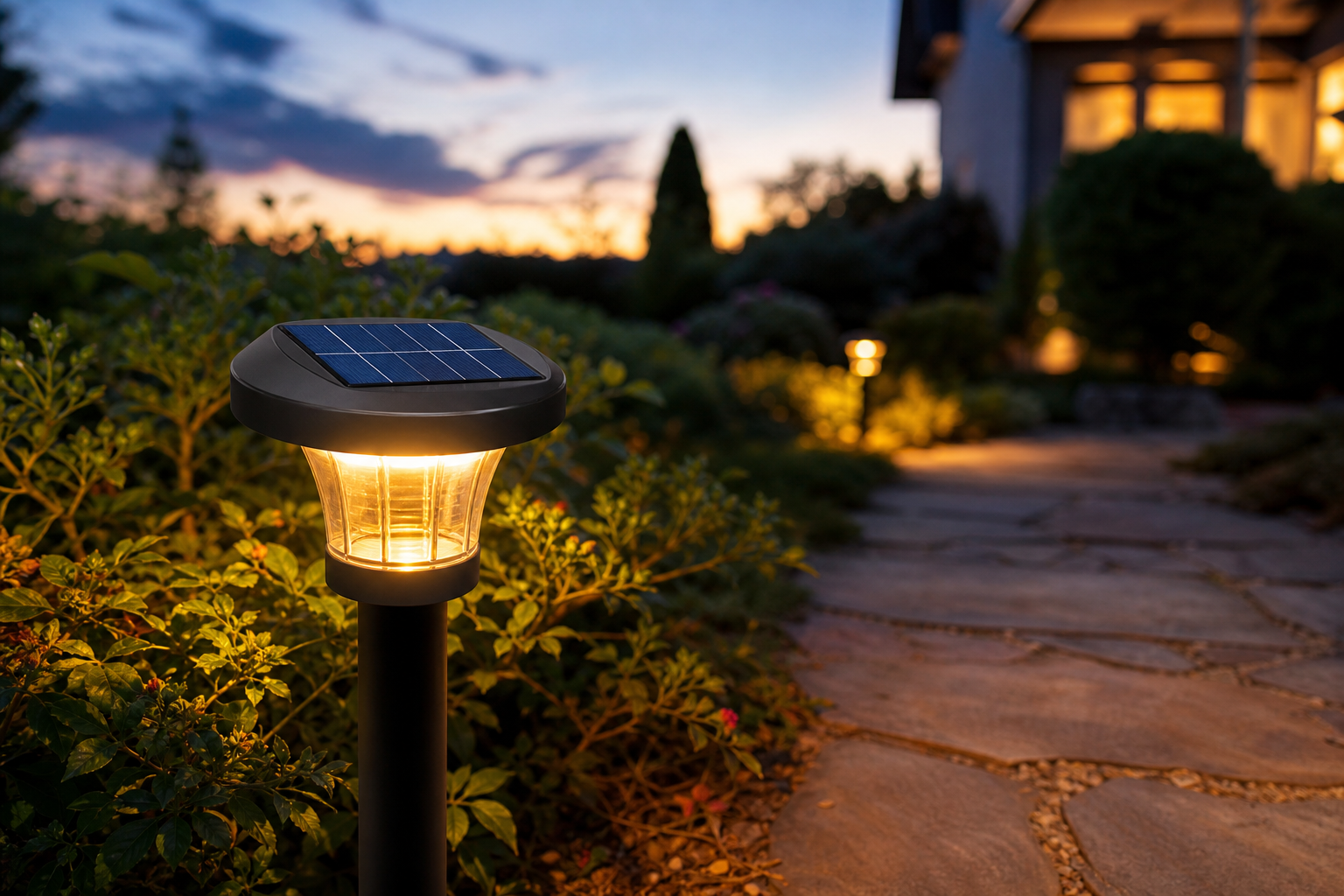
The dark panel on top is a photovoltaic (PV) cell: when sunlight hits it, it converts that light directly into electricity. The bigger the panel and the stronger the sun, the more power it makes — which is why panel size and placement matter so much.
2. The rechargeable battery
Sunlight only shines by day, but you want light at night — so a rechargeable battery stores the panel’s energy for later. Capacity is measured in milliamp-hours (mAh): our Solar Flame Torch Lights use a 2200mAh cell. A larger battery holds more charge and runs longer, and like any rechargeable, these cells slowly wear out and are typically replaced every year or two.
3. The dusk-to-dawn sensor
A tiny light sensor watches the surrounding light level. As daylight fades it switches the LED on; when the sun returns it turns the light off so the panel can recharge — the dusk-to-dawn behavior that means no timer and no switch. Some lights add manual control too: our solar string lights with remote layer three brightness levels on top of the sensor (more in our string lights guide).
4. The LED
Finally, the light comes from LEDs (light-emitting diodes). LEDs make solar lighting practical: they’re extremely energy-efficient and draw very little power, so even a small battery can keep them glowing for hours on one day’s charge.
How solar lights charge during the day
Charging happens quietly whenever daylight reaches the panel. The PV cell turns sunlight into electricity, and that current trickles into the battery, topping it up over several hours — a typical outdoor solar light needs roughly 6–8 hours of good sun for a full charge, the same window our torches and solar house-number signs use.
Direct sun matters more than just “daylight”: panels charge fastest in bright, unobstructed sunlight and far more slowly in shade or heavy cloud, which leaves the battery less than full by nightfall. A few products skip the battery entirely — our floating solar water fountain runs straight off its panel, so it only bubbles while the sun shines and pauses under clouds.
Why runtime changes with the season and weather
This is the honest limitation of every solar light: how long it runs at night depends on how much sun it got that day. Our Solar Flame Torch Lights show the gap clearly — up to about 12 hours a night in summer, but closer to 5 hours in winter, purely because there’s less sunlight to harvest.
Shorter winter days, overcast skies, and shade — from trees, walls, or even a dusty panel — all shrink runtime. None of it means the light is faulty; it’s just working with less fuel. If you need dependable cold-season performance, see the best solar lights for winter.
No wiring, no outlets, no electricity bill
Because the panel, battery, sensor, and LED are sealed into one unit, a solar light is completely self-powered: no cables to bury, no transformer, nothing to plug in. You place or stake it where it gets sun and it handles the rest — which is what makes solar so easy to install where a wired fixture could never reach. Our solar post cap lights, for instance, sit right on a fence or deck post with zero wiring, and there’s no running cost because the sun charges them for free.
How to get the most out of your solar lights
- Chase the sun. Put the panel where it gets the most direct daylight — ideally 6–8 hours, and south-facing in the US.
- Keep panels clean. Dust, pollen, and grime block sunlight; a quick wipe restores charging.
- Avoid nearby light. A bright porch or street light can trick the sensor into “seeing” daytime, so it never switches on.
- Charge fully first. Give new lights a day or two of sun before judging their runtime.
- Mind the season. Expect shorter winter run times, and pick a spot without deep shade.
Still deciding whether solar is the right call for your yard? Our guide on whether solar lights are worth it weighs the real pros and cons.
Frequently asked questions
Do solar lights need direct sunlight to charge?
They charge best in direct, unobstructed sun. In cloud or shade they still charge, but much more slowly, so the battery ends up less than full and runs down sooner. Place the panel where it gets several hours of unblocked daylight.
Do solar lights work in winter?
Yes, but for less time. Shorter days and weaker sun mean less charge — our Solar Flame Torch Lights run up to about 12 hours in summer but closer to 5 in winter. Snow or frost on the panel also blocks charging until it’s cleared.
Do solar lights turn on automatically?
Yes. A built-in dusk-to-dawn sensor switches them on at dark and off at dawn, with no timer or switch needed. They run on the battery’s stored charge until sunrise or until it’s spent.
How many hours do solar lights last per night?
It depends on the product and that day’s sun. From our range: the flame torches run up to 12 hours in summer, the string lights up to 10 hours, and the house-number signs about 9 hours on a full charge. Cloudy or winter days shorten all of these.
Do solar lights need any wiring?
No. Each light is self-contained — panel, battery, sensor, and LED in one sealed unit — so there are no wires, plugs, or outlets. That’s why you can install them anywhere that gets sun, including a fence post or deck rail.
More guides
- Solar flame torch lights — the complete guide
- Solar string lights with remote — buyer’s guide
- Best solar lights for winter — what actually works
Specifications are current as of publication and may change. See product pages for details.
Sources and editorial methodology
- U.S. Department of Energy: How Does Solar Work?
- U.S. Department of Energy: Solar Photovoltaic Performance and Efficiency Basics
- U.S. Department of Energy: Solar Energy and Storage Basics
Editorial policy: We distinguish established technical principles and manufacturer specifications from firsthand testing. Product-specific performance should be confirmed from the product listing and real installation conditions.