.png?w=2172&h=724)

Reviewed and updated July 18, 2026 by the Solar Outdoor Light Deals Editorial Team.
Quick answer
When a solar light stops working, check the simple causes first: an off switch or shipping tab, a shaded or dirty panel, nearby nighttime light confusing the sensor, a loose battery connection, or an aging rechargeable battery. Diagnose one variable at a time instead of immediately replacing the whole fixture.
| Symptom | Likely cause | First check |
|---|---|---|
| Never turns on | Switch, tab, or battery contact | Confirm setup and battery seating |
| Works briefly | Insufficient charge or weak battery | Clean panel and charge in open sun |
| Works indoors but not outside | Nearby light reaches sensor | Test in full darkness |
| Intermittent after rain | Moisture or connection issue | Dry safely and inspect seals |
Evidence note: This guide does not claim laboratory or firsthand test results. Product-specific specifications should be confirmed on the product page.
Quick answer: Most solar lights that stop working aren’t broken — they’re just not charging. Check that the ON/OFF switch is on and any plastic pull-tab is removed, wipe the solar panel clean, and move it somewhere it gets 6+ hours of direct daily sun. Aging batteries, a confused dusk sensor, or shorter winter days explain nearly everything else.
When a solar light quits, it’s almost never a dead unit — it’s a charging problem you can usually fix in minutes. A solar light powers itself from a small panel and stores energy in a rechargeable battery, so most faults trace back to the panel, the battery, or the light sensor. This guide works for any solar light — path, string, torch, spotlight, or post-cap.
Start with the 30-second checks
Before assuming anything is faulty, rule out the basics — they explain most “dead” solar lights:
- Turn the switch on. Many ship OFF or get bumped; look under the unit or inside the battery cap.
- Remove the pull-tab. New lights have a clear plastic tab that disconnects the battery in the box.
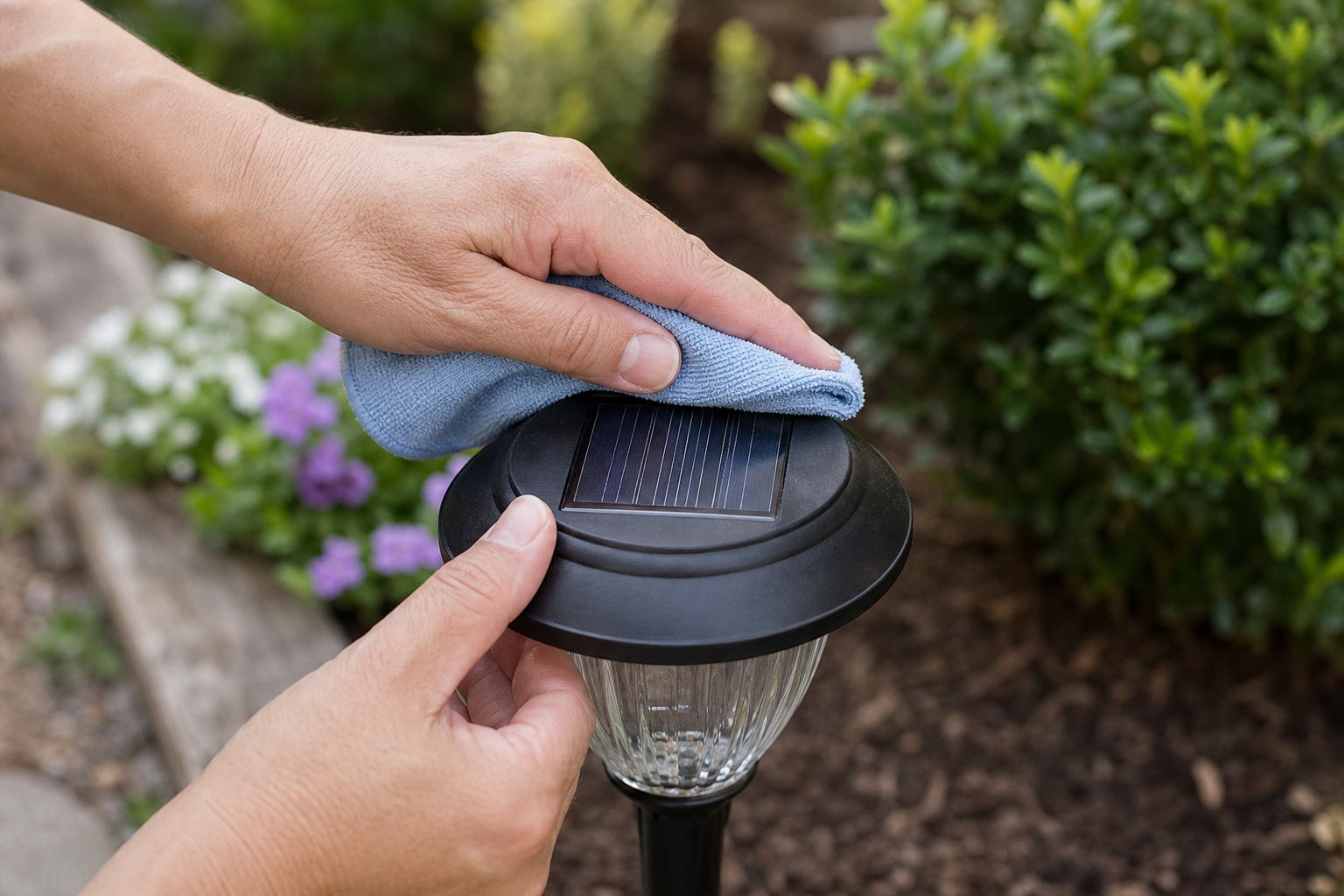
- Wipe the panel. Dust, pollen, or water spots block sunlight and slowly dim a light.
- Give it sun and time. A first charge can take 2–3 sunny days — don’t judge it after one cloudy afternoon.
Why won’t my solar lights charge?
Charging is where most problems live. The panel needs direct sun — not bright shade, not light through a window, and not a spot that’s sunny at breakfast but shaded by noon. Aim for 6+ hours of direct daily sun on the panel.
Walk out at midday and see where the panel sits. Common charge-killers: a tree that leafed out, a patio umbrella, or an eave shading it half the day. On string lights and spotlights, the bulbs can sit in shade as long as the panel is in the open. See our guide on how to charge solar lights the right way for more.
Why won’t my solar lights turn on at night?
If the panel is charging but the light stays dark after sunset, blame the dusk-to-dawn sensor. It keeps the light off whenever it detects light — so a nearby porch light, street lamp, or floodlight can trick it into thinking it’s still daytime.
In daytime, cover the panel with your hand — a working light glows within seconds, proving the unit is fine and the issue is charge or placement. Move it a few feet from that lamp so the sensor sees true darkness. If it lights but won’t last the night, the battery isn’t holding charge — see below.
Why are my solar lights dim or flickering?
Dim, weak, or flickering light almost always means low charge or an aging battery. After cloudy days the battery hasn’t stored much, and brightness recovers with sun. If dimness is permanent, the battery is worn: the cells in solar lights hold strong capacity for about 1–2 years, then fade. Many lights use standard AA or AAA rechargeable (NiMH) cells, so a fresh set often revives a “dying” light — see how to make solar lights last longer.
They worked before, then stopped — what changed?
When a light that used to work goes dark, something changed. Check for:
- New shade — seasonal growth, moved furniture, or a parked vehicle now blocks the panel.
- A dirty panel — dust, pollen, or bird droppings.
- A bumped switch or loose cap that flipped it off or let moisture in.
- A worn battery, if the light is 2+ years old.
The fix for most is a reset: switch off, clean the panel, charge in full sun 2–3 days, then switch back on. One honest exception — a solar water fountain that stops when a cloud passes isn’t broken. It has no battery and runs on direct sun only, so pausing in shade is normal, as our solar fountain troubleshooting guide explains.
Do solar lights work in winter?
Yes — but expect shorter runtime, and that’s normal, not a fault. Winter brings fewer daylight hours and a low sun angle, so the battery collects less each day, and snow on the panel blocks it entirely. Real specs show it: our solar flame torch lights run up to about 12 hours a night in summer but closer to 5 in winter. Keep panels clear of snow and tilt them toward the low sun. For a torch-specific checklist, see our solar flame torch troubleshooting guide.
Quick diagnosis table
| Symptom | Most likely cause | Fix |
|---|---|---|
| Won’t charge | Dirty or shaded panel; too little direct sun | Clean panel; relocate for 6+ hours of direct sun |
| Won’t turn on at night | Switch off, pull-tab in, or sensor sees nearby light | Switch on, remove tab, move away from other lights |
| Dim or flickering | Low charge, or aging battery (1–2+ years) | Charge fully; replace the rechargeable battery |
| Worked, then stopped | New shade, dirty panel, bumped switch, or dead battery | Re-check panel & switch; reset with 2–3 sunny days |
| Shorter runtime in winter | Fewer, weaker daylight hours (expected) | Normal — clear snow and angle panel to the sun |
Keep them working longer
- Place panels in real, direct midday sun, and wipe them clean every few weeks.
- Keep lights away from porch and street lights that confuse the sensor.
- Replace rechargeable batteries every 1–2 years to restore full brightness.
Frequently asked questions
Why did my solar lights suddenly stop working?
Usually something changed around them: new shade over the panel, a dirty panel, a switch bumped off, or a battery at the end of its life. Clean the panel, confirm the switch is on, and charge in full sun for 2–3 days before assuming it’s faulty.
How long do solar light batteries last?
Most hold strong capacity for about 1–2 years, then runtime and brightness gradually drop. Many solar lights use standard AA or AAA rechargeable cells you can replace yourself, which restores full performance.
Do solar lights need direct sunlight to charge?
Yes. The panel needs roughly 6 or more hours of direct daily sun — bright shade or light through a window won’t fully charge it. On separate-panel sets, the bulbs can be in shade if the panel is in the sun.
Why do my solar lights stay off at night but light up when I cover the panel?
The light works — the dusk sensor is fooled by nearby artificial light, such as a porch lamp or street light reading as daytime and keeping it off. Move the light away from that source and it will switch on after dark.
Do solar lights work in winter?
Yes, but with shorter runtime, which is normal. A light that runs 12 hours in summer may only run about 5 in winter. Keep the panel clear of snow and angled toward the sun for the best cold-weather results.
More guides
- How to charge solar lights the right way
- How to make solar lights last longer
- Best solar lights for cold-weather runtime
Specifications are current as of publication and may change. See product pages for details.
Sources and editorial methodology
- U.S. Department of Energy: Solar Radiation Basics
- U.S. Department of Energy: PV Performance and Efficiency Basics
- U.S. Department of Energy: Solar Energy and Storage Basics
Editorial policy: This guide distinguishes established technical principles and documented specifications from firsthand testing. Product-specific performance depends on the item and real installation conditions.