.png?w=2172&h=724)

Reviewed and updated July 18, 2026 by the Solar Outdoor Light Deals Editorial Team.
Quick answer
IP65 and IP67 are different ingress-protection classifications. In both, the first digit 6 denotes protection against dust ingress. The second digit describes water testing: 5 concerns water jets, while 7 concerns temporary immersion under the standard?s specified conditions. An IP rating does not guarantee permanent submersion, corrosion resistance, or identical real-world durability.
| Rating | Dust indication | Water-test category | Good fit |
|---|---|---|---|
| IP65 | 6: dust-tight classification | 5: water jets | Typical exposed outdoor fixtures |
| IP67 | 6: dust-tight classification | 7: temporary immersion test | Locations with greater temporary water exposure |
Evidence note: This guide does not claim laboratory or firsthand test results. Product-specific specifications should be confirmed on the product page.
IP65 vs IP67: An IP rating has two digits — the first is dust protection (6 = fully dust-tight), the second is water protection. IP65 resists water jets like rain and sprinklers; IP67 survives brief immersion in shallow water. For most yards IP65 is plenty; choose IP67 for heavy rain, snow, or damp coastal climates.
Every outdoor light carries a little “IP” code on the box, and it tells you exactly how much weather the fixture can take — if you know how to read it. Here’s what IP65 and IP67 really mean, how they differ, and which one you need for rain, sprinklers, snow, or salty coastal air.
What does an IP rating actually mean?
IP stands for “Ingress Protection.” It’s a standardized two-digit code that rates how well a sealed enclosure keeps out solids and liquids. Read the digits separately, not as a single number.
- First digit (0–6) — dust and solids. Higher is better, and 6 is the top: fully dust-tight, so no fine grit or debris gets inside over time.
- Second digit (0–8) — water. This is where lights differ most. A 5 means it shrugs off water jets; a 7 means it can be briefly submerged.
Both IP65 and IP67 share the same first digit — a 6 — so both are completely dust-tight. The whole difference between them comes down to that second, water-resistance digit.
IP65 vs IP67: what’s the real difference?
Think of it as a ladder of water exposure. IP65 is tested against low-pressure water jets sprayed from any direction — that covers rain, hose spray, and sprinklers. IP67 goes a step further: it’s rated for temporary immersion, roughly up to about 1 meter of water for up to 30 minutes. So an IP67 light can briefly sit underwater and keep working, while an IP65 light is built to be rained on, not dunked.
| Rating | Dust (1st digit) | Water (2nd digit) | Good for |
|---|---|---|---|
| IP65 | Dust-tight | Water jets from any direction | Rain, sprinklers, everyday open-air fixtures |
| IP67 | Dust-tight | Temporary immersion (~1m, ~30 min) | Heavy rain, pooling water, snow, low-mounted lights |
| IP68 | Dust-tight | Continuous immersion to a stated depth | Ponds and underwater fixtures (specialist gear) |
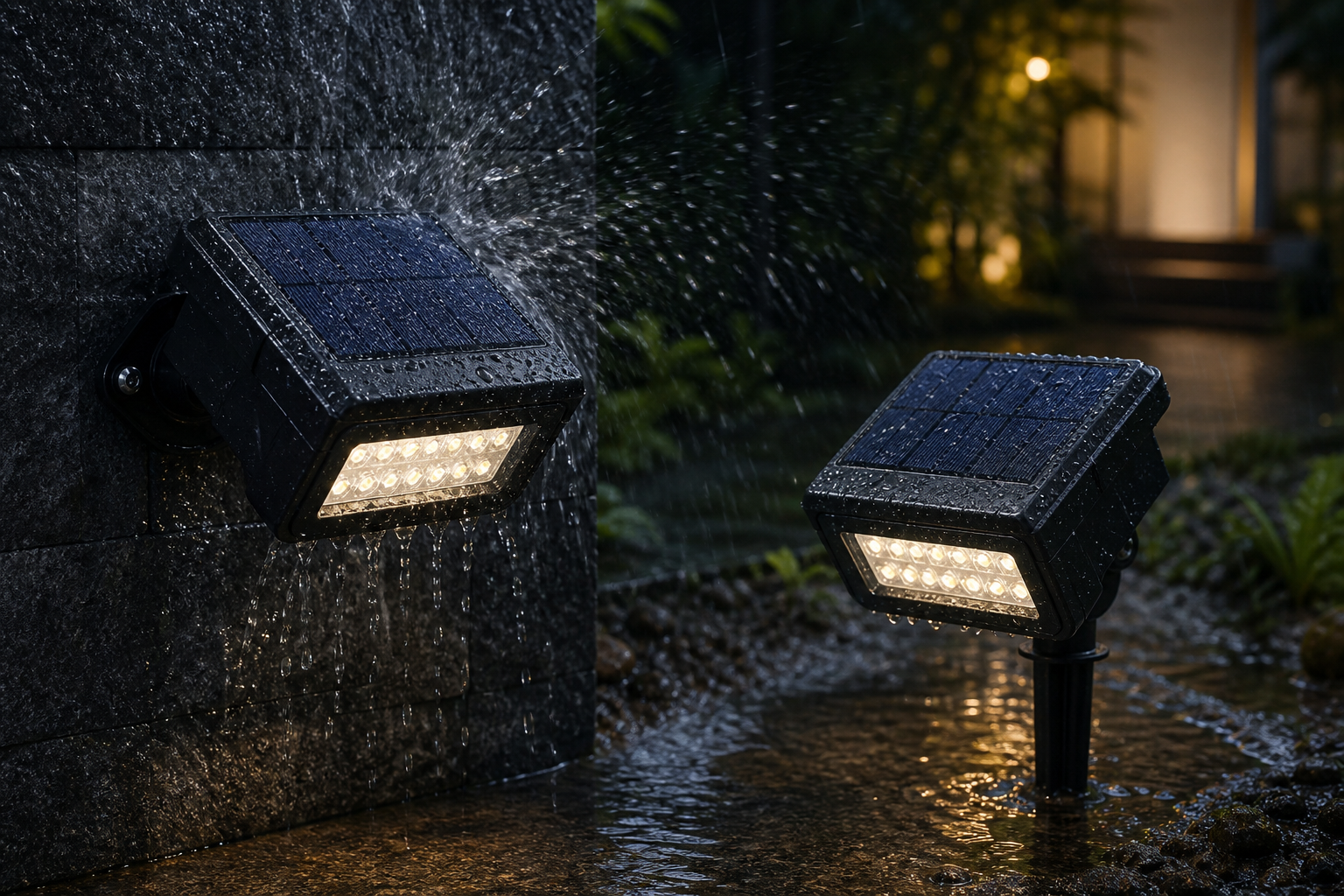
On our own shelves, the difference is easy to see. Our Solar Flame Torch Lights are rated IP67 — they stake low into the ground on a long spike, right where rain and melting snow pool, so the higher water rating earns its keep (full setup details are in the solar flame torch lights guide). Our wireless solar motion sensor lights are IP65 — they mount up on a wall where water runs off instead of collecting, so jet-level protection is all they need.
Which rating do you need for rain, sprinklers, snow & coastal climates?
Here’s the practical breakdown by what you’re actually up against:
- Rain: IP65 is enough. The “5” water test is literally a jet of water aimed at the fixture, so ordinary rainfall — even a downpour — is well within its limits.
- Sprinklers: IP65 again. A sprinkler is basically a directed water jet — exactly what the rating is built to resist.
- Snow: Lean IP67. Snow itself is harmless, but as it melts it pools around a fixture’s base and refreezes overnight. That standing water is where IP67’s immersion margin pays off, especially for low, ground-level lights.
- Coastal & very wet climates: Lean IP67 for the extra headroom against persistent humidity, heavy storms, and flooding puddles. One honest caveat: IP tests use fresh water, not salt, so near the coast you should also check that the housing and hardware resist corrosion — a rating protects against water getting in, not against salt eating the metal.
Does a higher rating mean I can leave it underwater forever?
No — and this is the myth worth killing. Even IP67 only covers temporary immersion: about 30 minutes in shallow water, then it should come back out. IP68 allows continuous immersion, but only down to a specific depth the manufacturer states — not “any depth, forever.” There is no IP rating that means “submerge it permanently and forget about it.” Sustained pressure and time will eventually work water past any seal.
There’s a second reason not to drown a solar light: it needs sunlight to charge. A fixture sitting underwater or buried under snow can’t reach its panel, so it won’t power up regardless of how waterproof it is. Treat immersion ratings as a safety margin against bad weather, not an invitation to submerge the light.
How to choose the right rating for your yard
- Elevated, wall-mounted, or under an eave? IP65 is plenty — water runs off before it can sit.
- Low to the ground, path-level, or in a heavy-weather spot? Go IP67, where pooling water is a real risk.
- Coastal or constantly humid? IP67 plus corrosion-resistant materials.
- Whatever the rating, close battery doors fully and angle the solar panel so water sheds off rather than collecting on top.
And remember: waterproofing keeps weather out, but shorter, cloudier winter days still mean less charge and shorter run times. The IP number protects the hardware — it can’t add sunlight.
Is IP65 waterproof enough for rain?
Yes. The “5” means the light is tested against water jets from any direction, which comfortably covers rain and sprinkler spray. IP65 fixtures like our wireless solar motion sensor lights are built to stay outside in the rain year-round — just don’t submerge them.
What is the difference between IP65 and IP67?
Both are fully dust-tight, shown by the shared first digit “6.” The difference is the water digit: IP65 resists water jets, while IP67 survives temporary immersion of about 30 minutes in shallow water. IP67 is the safer choice wherever water can pool or the fixture sits low.
Can I leave IP67 solar lights out in the snow?
Yes. IP67 handles melting snow and the water that pools and refreezes around a fixture’s base far better than lower ratings. Just expect shorter run times in winter — the waterproofing is fine, but short, cloudy days give the solar panel less to work with.
Does IP67 mean I can put the light underwater permanently?
No. IP67 covers brief, temporary immersion only, not permanent submersion. No IP rating means “submerge it forever” — even IP68 is limited to a depth the maker specifies. Keep solar lights above the waterline so the panel can still charge.
Which rating is best for a coastal or very humid yard?
Lean toward IP67 for the extra margin against heavy rain and constant damp. One important note: IP tests use fresh water, not salt, so in coastal areas also check that the housing and hardware are corrosion-resistant, since salt attacks metal even when water can’t get inside.
More guides
- Best solar lights for winter
- Solar vs. low-voltage landscape lighting
- Best solar lights for your patio
Specifications are current as of publication and may change. See product pages for details.
Sources and editorial methodology
- International Electrotechnical Commission: IP ratings explained
- U.S. Department of Energy: PV Performance and Efficiency Basics
- DarkSky International: Five Principles for Responsible Outdoor Lighting
Editorial policy: This guide distinguishes established technical principles and documented specifications from firsthand testing. Product-specific performance depends on the item and real installation conditions.