.png?w=2172&h=724)

Reviewed and updated July 18, 2026 by the Solar Outdoor Light Deals Editorial Team.
Quick answer
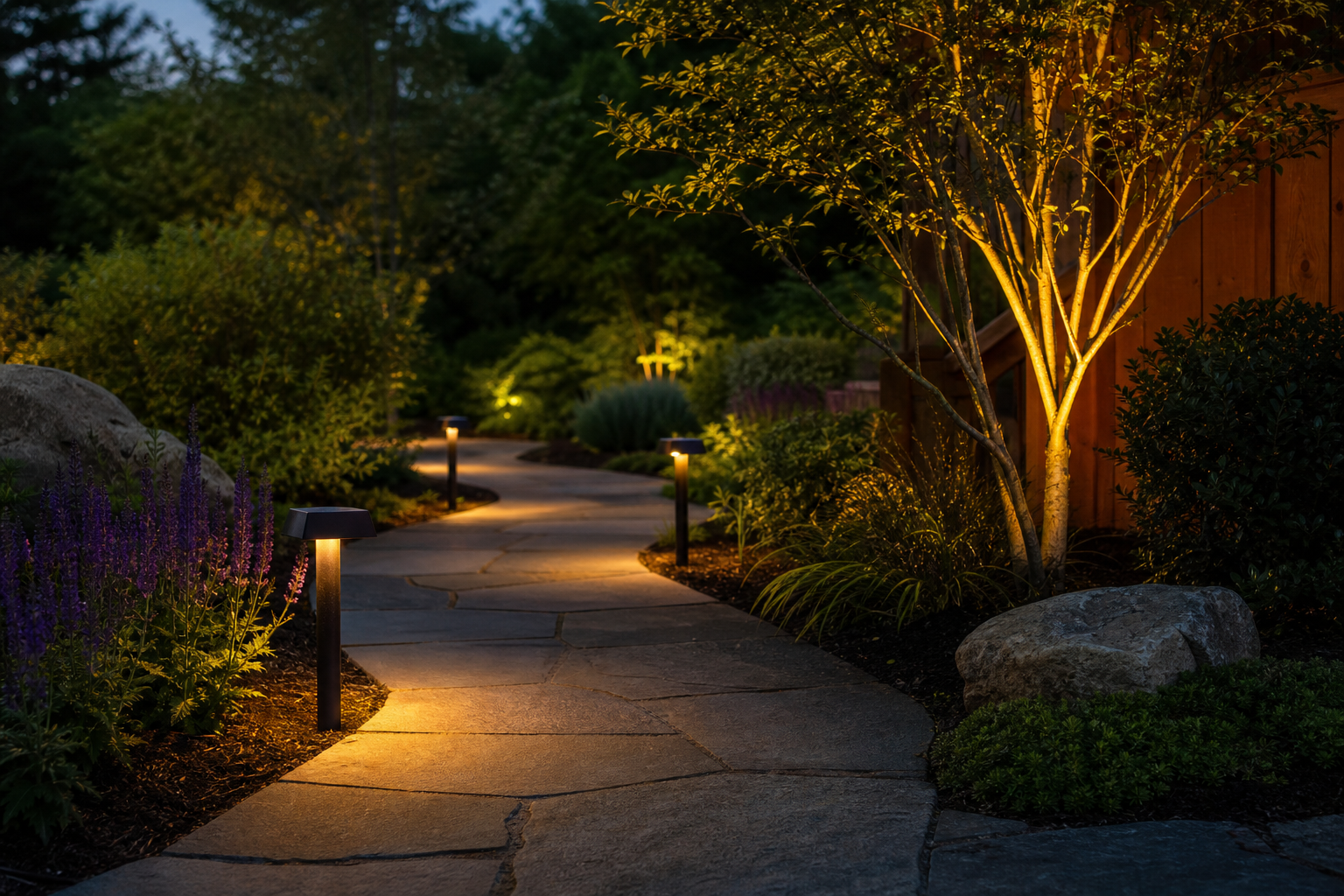
Choose solar path and landscape lights by function before style. Path lights should make edges and level changes easier to see without producing harsh glare; spotlights should emphasize selected features; decorative lights should create ambience. Every fixture still needs a viable charging location and weather suitability.
| Application | Recommended approach | Common mistake |
|---|---|---|
| Walkway edge | Low, shielded, evenly spaced light | Creating alternating bright and dark patches |
| Steps or level changes | Place light where the hazard is visible | Aiming directly into eye level |
| Tree or wall accent | Use a controlled beam | Overlighting the whole yard |
| Garden ambience | Use warm, modest output | Choosing brightness without considering glare |
Evidence note: This guide does not claim laboratory or firsthand test results. Product-specific specifications should be confirmed on the product page.
Solar path and landscape lights are stake-mounted accent lights that charge by day and switch on by themselves at dusk—no wiring, transformers, or outlets. Space them about every 6–8 feet along walkways, beds, and borders. Expect a soft, decorative glow rather than floodlight brightness, and shorter runtime in winter.
Good landscape lighting does two jobs at once: it makes a yard look finished after dark and helps people find the way to your door. Solar versions do it without a single wire—each light is a self-contained stake that charges by day and glows on its own at night. Here’s how the types differ, where to place them, how far apart to set them, and how to keep them glowing all year.
The four main types of solar path & landscape lights
Most solar landscape lighting falls into four buckets, and it’s worth mixing them rather than buying one style for the whole yard:
- Stake garden lights. The classic path light—a small head on a stem that casts a downward pool of light. Solar garden outdoor lights are the everyday workhorse for lining a walk or a bed.
- Glass globe stakes. Cracked-glass solar globes throw a patterned, sparkling glow instead of a plain beam—more decoration than task light, and lovely tucked in among plants.
- Brick & paver lights. The solar glass brick path light sits low and waterproof right along the ground, marking the edge of a walkway with no tall stem to mow around.
- Adjustable-brightness yard lights. Solar yard lights with adjustable brightness let you turn the output up for a focal point or down to stretch runtime.
Need something stronger for uplighting a tree or wall? A solar waterproof spotlight is brighter than these decorative stakes. Browse every style in the landscape lighting collection.
| Type | Best for | Light style |
|---|---|---|
| Stake garden lights | Walkway & bed edges | Downward pool, path-marking |
| Glass globe stakes | Borders, among plants | Decorative, patterned sparkle |
| Brick / paver lights | Low along walkways | Ground-level marker glow |
| Adjustable-brightness yard lights | Focal points you want to tune | Dimmable, accent to medium |
Where should you place solar landscape lights?
Think of these lights as a way to trace the shapes already in your yard. The most useful spots are:
- Walkways & front paths—one on each side, or staggered, so the route reads clearly at night.
- Garden beds & borders—run a line along the edge to separate planting from lawn.
- Driveway edges—stakes mark where the pavement ends so tires stay on it; our best solar lights for driveways guide goes deeper on this.
- Steps, corners & focal plants—a single light at a turn in the path or on a specimen shrub adds depth.
Wherever they go, the rule that matters most is sun: a light can only glow at night if its panel caught daylight, so keep stakes out of the shade of eaves, fences, and dense foliage.
How far apart should path lights be spaced?
A good starting point is one light every 6–8 feet along a path. That’s close enough to avoid dark gaps between the pools of light, but far enough that you don’t create an airport-runway look. Dimmer, decorative styles like glass globes can sit a little closer together; brighter or adjustable lights can stretch toward the wider end. Measure your run, divide by roughly seven, and that’s about how many you’ll need.
How do you install solar stakes?
Installation is the best part—there’s no wiring, no transformer, and no outlet involved. Most stakes arrive in a few pieces:
- Snap the head onto the stem, and the stem onto the pointed stake.
- Pick your spot, loosen the soil, and push the stake straight down until it’s firm.
- In hard, dry, or frozen ground, make a pilot hole first with a screwdriver or rod so the plastic stake doesn’t snap.
- Angle each light so its solar panel faces open sky—south-facing collects the most sun in the U.S.
That’s it. They charge by day and switch on automatically at dusk and off at dawn, so there’s no timer to set and nothing to plug in.
How bright are solar path lights, really?
Set expectations here: solar path and landscape lights are accent lighting, not floodlights. They’re built to mark edges, add ambiance, and guide the eye—not to light up the whole yard like a porch fixture. That gentle output is also why they glow all evening on a small panel and battery. If you want genuine brightness for security, or to wash light up a tree or wall, step up to a solar spotlight or the flood & security lights, and let the stakes handle the finishing touch.
Getting good winter & low-sun performance
Honest truth about anything solar: it runs shorter in winter and after cloudy days. Shorter daylight, a low sun, and snow or leaves on the panel all mean less charge—a light that lasted till dawn in July might fade before midnight in December. A few habits keep them at their best:
- Put panels where they get direct midday sun, not just ambient daylight.
- Wipe dust, pollen, and snow off the panels every few weeks—a filmy panel charges poorly.
- Tilt lights toward the low winter sun where you can.
- Use any brightness or on/off setting to conserve charge on short days.
For a full seasonal rundown, see our best solar lights for winter guide. And if you’re weighing solar against a wired system, solar vs. low-voltage landscape lighting compares the two head to head.
How to choose the right mix
Quick rules of thumb: use stake garden lights to mark paths, glass globes and brick lights for decoration, and adjustable yard lights wherever you want control. Buy enough to hit that 6–8 foot spacing, give every panel a real view of the sky, and mix a couple of styles rather than repeating one light down the whole run.
How far apart should solar path lights be spaced?
Space them about every 6–8 feet along a path or bed edge. That keeps the pools of light close enough to avoid dark gaps without looking like a runway. Set dimmer, decorative styles a little closer together and brighter ones farther apart.
Do solar landscape lights need any wiring?
No. Each light is a self-contained stake with its own panel and battery—you just push it into the ground. There are no wires, transformers, or outlets, and it charges by day, then switches on automatically at dusk and off at dawn.
Are solar path lights bright enough to light up a yard?
They’re accent lights, not floodlights. Expect a soft glow that marks edges and adds ambiance rather than lighting the whole yard. If you need real brightness for security or uplighting, use a solar spotlight or a motion flood light instead.
Why do my solar lights get dimmer in winter?
Shorter days and a lower sun mean the panels collect less energy, so runtime drops in winter and after cloudy days. Snow, leaves, or dust on the panel make it worse. Keep panels clean and in direct sun to get the most out of them.
Can I use solar path lights along a driveway?
Yes. Staked lights along a driveway edge mark where the pavement ends so tires stay on it. Give the panels an open view of the sky, away from the shade of parked cars and walls—see our driveway guide for placement tips.
More guides
- Solar vs. low-voltage landscape lighting
- Best solar lights for your driveway
- Best solar lights for winter
Specifications are current as of publication and may change. See product pages for details.
Sources and editorial methodology
- DarkSky International: Five Principles for Responsible Outdoor Lighting
- U.S. Department of Energy: Solar Radiation Basics
- U.S. Department of Energy: How Does Solar Work?
Editorial policy: This guide distinguishes established technical principles and documented specifications from firsthand testing. Product-specific performance depends on the item and real installation conditions.