.png?w=2172&h=724)

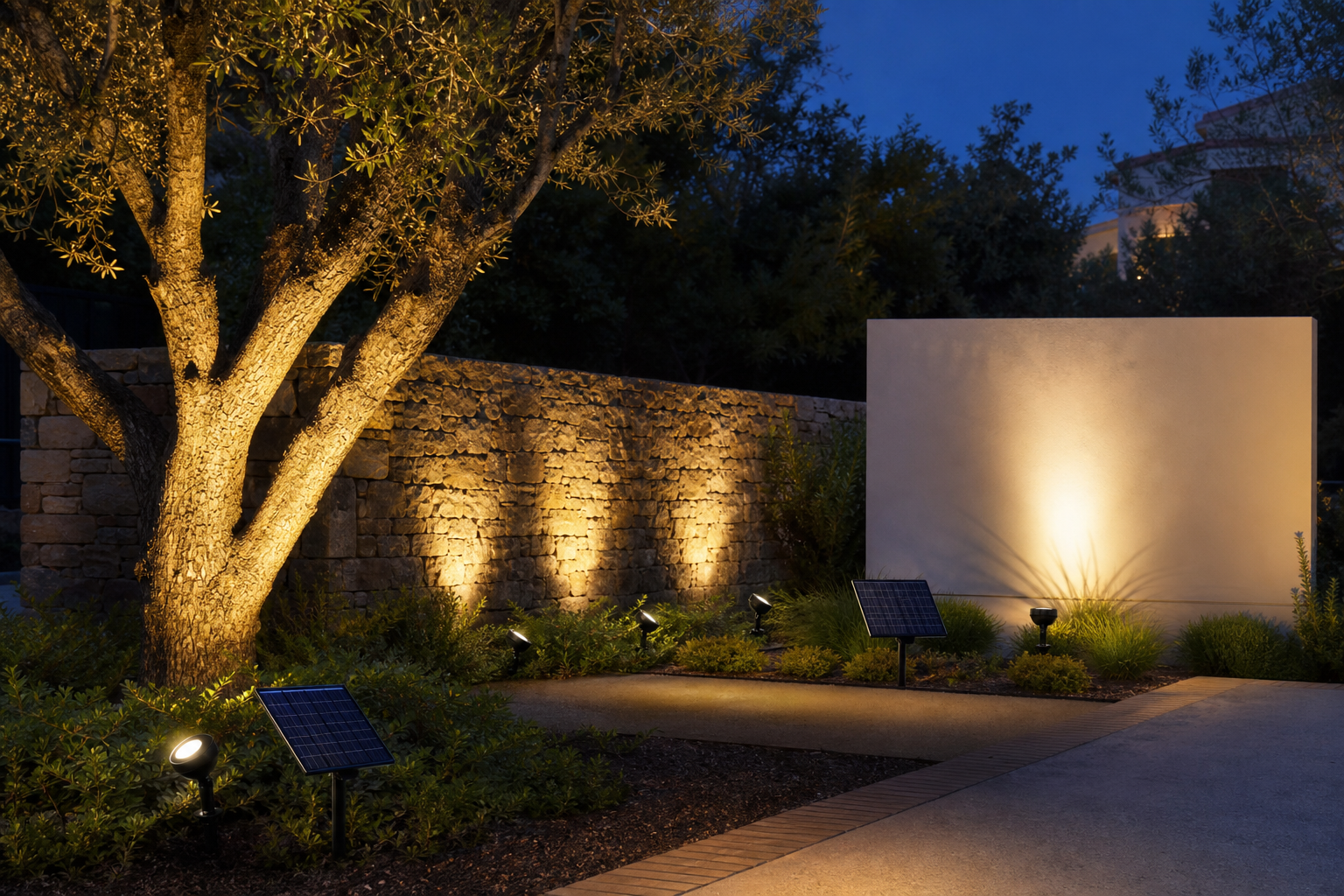
A solar spotlight throws a focused, directional beam that’s far brighter than a decorative path light, so it can uplight a tree, wash a wall or fence, or pick out a flag, sign or house feature. You aim the adjustable head at the target, and the built-in panel recharges by day — no wiring or outlets needed.
Most solar landscape lights are built to be looked at — soft globes and path markers that add a gentle glow of their own. A solar spotlight does the opposite job: instead of glowing prettily by itself, it points a concentrated beam at something you want people to notice. That makes it the go-to fixture for accenting trees, walls, flags and architecture after dark. Here’s how they work, where to place them, what brightness to realistically expect, and the honest truth about running them on sunlight alone.
What does a solar spotlight actually do?
A spotlight’s job is direction. Rather than scattering light in every direction the way a globe or lantern does, it concentrates a beam and sends it where you aim the head. That’s what lets it “paint” a single feature — a tree trunk, a slice of brick wall, a flagpole — and make it stand out from everything around it.
Our Solar Waterproof LED Spotlights are built for exactly this: a brighter, more focused beam than a decorative path light, in a waterproof housing made to stay outdoors. Like the rest of our solar range, they charge by day, switch on automatically at dusk and off at dawn, with no wiring, no outlet and no running cost.
What can you light with a solar spotlight?
Almost any feature you’d want to show off after sunset. The most popular uses, all part of our landscape lighting range, are:
- Uplighting trees. Set the fixture at the base and aim the beam up the trunk into the canopy. Textured bark and spreading branches catch the light beautifully.
- Washing a wall or fence. Point the beam up a flat surface to graze it with light and reveal the texture of brick, stone or timber.
- Highlighting a flag. Keep a flag readable and visible at night — a common reason people add a single aimed spotlight.
- House features. Columns, gables, an entryway, a garden statue or a water feature all become focal points with one well-placed beam.
- Signs and markers. A house sign or business sign stays legible once the sun goes down.
How do you place and aim a solar spotlight?
Placement is where a spotlight earns its keep, so it’s worth a few minutes of fiddling.
- Use the adjustable head. Most solar spotlights let you tilt and rotate the light head to aim the beam, and many let the solar panel angle separately toward the sun. Check the product page for the exact adjustment range on the model you choose.
- Aim for the effect you want. Placing the fixture close to a tree or wall gives a tight, dramatic column and a grazing effect that shows texture; setting it farther back spreads a broader, softer wash.
- Avoid glare. Don’t aim the beam into your own windows, a neighbor’s yard or oncoming traffic.
- Give the panel sun. Position the solar panel where it gets the most direct midday sun, clear of shade and away from the very feature you’re lighting.
- Stake it firmly. Push the ground stake fully into soft soil; hard surfaces will need a different mount.
- Space multiples evenly. One spotlight suits a small feature; line several up at even intervals to wash a long wall or fence.
How bright are solar spotlights? Honest expectations
A solar spotlight is meaningfully brighter and more focused than a decorative path or globe light — that’s the whole point of the design. But it’s worth being realistic: a solar spotlight is an accent light, not a floodlight or a security light. It will make a tree or wall glow attractively; it won’t turn your yard into daylight.
Output also depends on how much sun the panel banked that day. A full charge is brighter and lasts longer than a charge collected under thick cloud. If you need serious, steady, all-night brightness, a wired system is stronger and more consistent — solar trades some of that power for the freedom of no cables and no trenching. Our solar vs low-voltage landscape lighting guide walks through the trade-offs in detail. And if what you really want is a broad, bright pool of light over a driveway, a motion or flood option may fit better — see our best solar lights for a driveway roundup.
How solar charging works — and the winter reality
The panel converts daylight into stored charge; a built-in dusk-to-dawn sensor then switches the light on at nightfall and off in the morning, hands-free. No outlet, no wiring, no electricity bill.
The single biggest factor in performance is direct sun on the panel. Aim it at open, unobstructed midday sky, trim any overhanging branches, and don’t tuck the panel into the shade of the tree you’re trying to light. Keep the glass clean.
Now the honest part: solar lights run shorter on short, low-angle winter days and after cloudy or snowy stretches — expect noticeably fewer hours than a long summer evening. Snow or fallen leaves sitting on the panel cut output further, so brush them off. On the plus side, because these spotlights are waterproof they can stay outside through rain and snow year-round. For cold-climate strategy, our best solar lights for winter guide has more.
Solar spotlight vs decorative path lights
Spotlights and decorative lights aren’t rivals — they do different jobs, and a good yard usually uses both.
| Solar spotlight | Decorative path & globe lights | |
|---|---|---|
| Beam | Focused and directional — you aim it | Soft glow spread in every direction |
| Best job | Highlight a tree, wall, flag or sign | Line a path, edge a bed, add sparkle |
| Placement | Pointed at a target, adjustable head | Staked in a row along a walkway |
| Brightness feel | Brighter, concentrated accent | Dimmer, purely decorative |
| Example | Solar Waterproof LED Spotlights | Glass brick path lights, cracked-glass globes |
Quick tips for a pro-looking result
- Pick the target first. Decide what you’re lighting — a tree, a wall, a flag — then work out how many fixtures it needs.
- Layer your lighting. Use spotlights to accent features and path or globe lights to line walkways, so the eye has both highlights and gentle guidance.
- Dial in the glow. If you want adjustable output elsewhere in the yard, solar yard lights with adjustable brightness let you tune the level to taste.
- Give every panel its own sunny spot. A shaded panel is the number-one reason a solar light underperforms.
- Aim after dark. Walk the yard once the lights come on and nudge each head until the effect looks right.
Frequently asked questions
Are solar spotlights bright enough to light up a tree?
Yes, for accenting a tree or shrub. A solar spotlight casts a focused beam that’s noticeably brighter than a decorative path light, enough to uplight a trunk and canopy. Remember they’re accent lights rather than floodlights, and brightness depends on how much sun the panel collected that day, so a full charge performs best.
Where should I put the solar panel?
Wherever it gets the most direct midday sun — clear of shade, snow and overhanging branches. On some solar spotlights the panel sits on the fixture itself; on others it’s on a short lead so you can angle it separately toward the sky. Keep the glass clean for the best charge.
Can a solar spotlight wash light up a wall or fence?
Yes. Set the fixture a little out from the surface and tilt the head upward. Positioning it closer gives a tight grazing effect that shows off texture, while moving it back spreads a broader wash. Space several evenly to light a long wall or fence.
Do solar spotlights work in winter?
They do, but they run shorter on short, cloudy, low-sun winter days, and snow sitting on the panel cuts output. Brush the panel clean and angle it at the midday sun for the best result. Because these spotlights are waterproof, they can stay outside through the season.
Solar spotlight or low-voltage — which is brighter?
A wired low-voltage spotlight is generally brighter and steadier all night long. A solar spotlight trades some of that power for no wiring, no trenching and no running costs — a great fit if you want easy, cordless accent lighting and can give each panel a genuinely sunny spot.
More guides
- Solar vs low-voltage landscape lighting
- Best solar lights for a driveway
- Best solar lights for winter
Specifications are current as of publication and may change. See product pages for details.