.png?w=2172&h=724)

Reviewed and updated July 18, 2026 by the Solar Outdoor Light Deals Editorial Team.
Quick answer
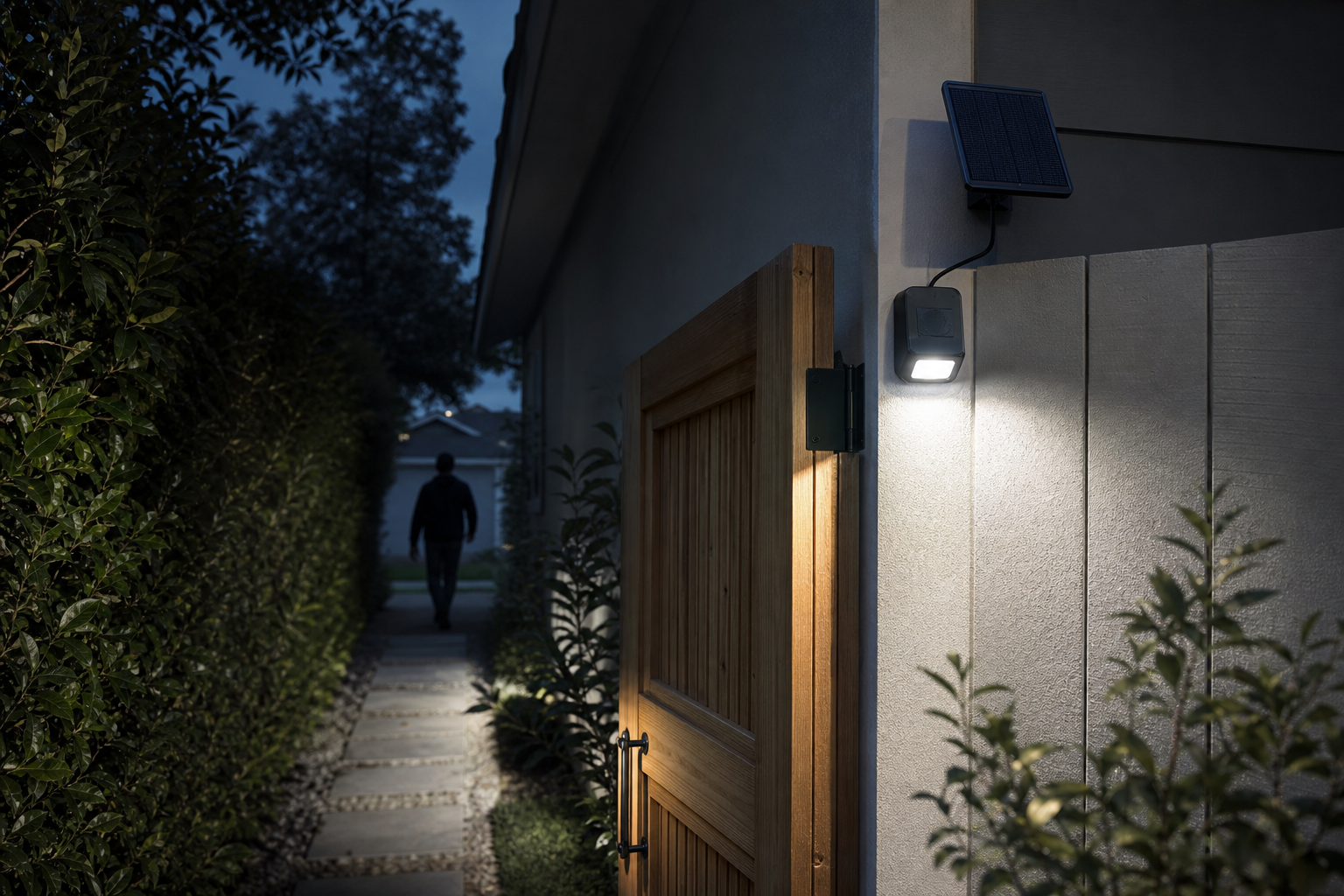
Solar motion lights are most useful when they illuminate a specific task area only when needed. Place the panel for strong daylight, aim the sensor across the expected approach path, keep the beam out of neighboring windows and the night sky, and choose output appropriate to the entrance, gate, driveway, or side yard.
| Placement | Goal | Avoid |
|---|---|---|
| Entry door | Light the lock and approach | Glare into visitors? eyes |
| Side yard | Detect movement across the path | Pointing sensor straight down the path |
| Driveway | Cover arrival zone | Aiming into traffic or neighbors |
| Gate or shed | Short task lighting | Permanent excessive brightness |
Evidence note: This guide does not claim laboratory or firsthand test results. Product-specific specifications should be confirmed on the product page.
Do solar motion & security lights work? Yes. A PIR sensor detects body heat and movement, then fires a bright LED burst; the rest of the night the light rests, so one day’s solar charge lasts. Mount them about 6–8 ft high and aim across the path—not straight down—for the most reliable triggering.
Motion-activated solar lights sit in a sweet spot: the deterrence of a bright, sudden light with none of the wiring, trenching, or electrician bills. Because they jump to full brightness only when something moves, they sip power and recharge easily by day. Here’s how they work, what to realistically expect, and where and how to mount them so they actually deter.
How do solar motion sensor lights work?
Two systems share the job. By day, a small solar panel charges an internal battery—no outlet, no wiring. At night, a passive infrared (PIR) sensor watches for the mix of heat and movement a person, car, or animal gives off, then fires the LEDs at full brightness for a set period before switching off until the next trigger.
That on-demand behaviour is the whole efficiency trick. A decorative solar light that glows all night has to ration one charge across eight to ten hours; a motion light stays dark until triggered, so it can afford to be far brighter in the seconds that matter—from a battery that even a short winter day can usually top up.
Do solar motion lights actually work?
Yes—with honest expectations. A quality solar motion light throws enough sudden brightness to make an approaching person visible across a driveway and signal that the area is watched. It won’t match a hard-wired mains floodlight, but it needs no switch or socket, which is why people choose it for sheds, gates, and side returns. It’s also far brighter and more purposeful than a decorative solar light like a flame torch or string set, which are built for ambience, not security.
The honest caveat is winter. Solar output drops on short, overcast days, and snow or leaves on the panel cut charging further. Motion-only operation cushions this—since the light isn’t draining all night, even a reduced charge usually covers a normal evening. If your winters are long and dark, keep the panel clean and angled to the sun, and read our best solar lights for winter guide before you buy.
How high and at what angle should you mount them?
Mounting height and aim decide whether a motion light protects you or just annoys you. Two rules cover most installs:
- Height — around 6–8 ft. High enough that people can’t easily reach or tamper with it, low enough that the PIR sensor still reads movement at ground level. Too high, and the sensor looks over people’s heads.
- Angle — aim across the path, not straight down. PIR sensors detect movement that crosses the beam much better than movement heading directly at them, so let foot or vehicle traffic pass side-to-side through the zone.
Detection range on solar PIR units is a cone of several feet—plenty for a doorway, gate, or driveway mouth, but not a whole field. Give each light one zone to own instead of expecting one unit to cover the property. Where the aim is awkward, our adjustable LED solar lights let you fine-tune both light and sensor after mounting.
What IP rating do you need for weather?
Anything mounted outdoors needs a sealed housing, and the IP (Ingress Protection) rating tells you how sealed: the first digit is dust resistance, the second is water. For wall-mounted lights under the eaves or on a fence, IP65 is the practical baseline—dust-tight and built to shrug off rain and hose spray. Our wireless solar motion sensor lights carry an IP65 rating and mount with no wiring.
If a fixture sits low, where it could catch heavy runoff or brief pooling, you may want a higher second digit. We break down the difference in IP65 vs IP67 solar light waterproof ratings.
Best spots to position solar motion & security lights
Placement does more for security than raw brightness. Prioritise the routes someone would actually use—and the spots you want lit for your own safety.
- Front and back doors: the highest-value target. A light here brightens your own path when your hands are full and removes the shadow someone could hide in. A wireless unit like the outdoor solar motion light mounts beside the door with no electrician.
- Driveways and gates: light the entrance where cars and people funnel in, aiming across the opening rather than down its length. See best solar lights for driveway for a deeper walkthrough.
- Dark corners and side returns: the unlit gaps between house and fence are where people linger unseen. One light per corner, each owning its zone, closes them off—LED solar lights with a sensor for yard and garden suit these planted spots.
- Sheds, garages and outbuildings: usually nowhere near an outlet, which is where solar shines. To flood a large door or yard, the higher-output 500W LED solar light covers more ground from one fixture.
| Solar light | Best for | Good to know |
|---|---|---|
| Outdoor Solar Motion Light | Doors, entryways | Wireless security sensor, no wiring |
| Wireless Solar Motion Sensor Lights | Walls, fences, under eaves | IP65 weatherproof |
| LED Solar Lights with Sensor (Yard & Garden) | Dark corners, borders | Blends into planting |
| Adjustable LED Solar Lights | Awkward angles | Adjustable light & sensor aim |
| 500W LED Solar Light | Sheds, driveways, wide areas | Higher output, more coverage |
Quick tips for reliable performance
- Keep the panel clean and unshaded—even partial shade over the day cuts charging.
- Give a new light a day or two in the sun before judging its runtime.
- Aim the sensor across walkways and away from heat sources like vents, grills, and busy roads to limit false triggers.
Do solar motion lights work in winter?
Yes, though runtime is shorter than in summer, since short, cloudy days and snow or leaves on the panel reduce charging. Because a motion light stays dark until triggered, even a reduced charge usually covers a normal evening. Keep the panel clean and angled to the sun for the most runtime.
How high should I mount a solar motion sensor light?
Around 6–8 ft is the sweet spot for most homes. That’s high enough to deter tampering but low enough that the PIR sensor still reads movement at ground level. Mount it much higher and the sensor tends to look over people’s heads.
Should I aim a motion light down or across the path?
Aim it across the path of travel. PIR sensors detect movement crossing the beam far better than movement coming straight toward them, so having people or cars pass side-to-side gives faster, more reliable triggering.
Are solar motion lights bright enough for security?
For most homes, yes. Because they only light on movement, they can be far brighter in that moment than an all-night decorative light. They won’t rival a mains floodlight, but they cover entrances, corners and sheds well with no wiring.
What IP rating do I need for an outdoor motion light?
IP65 is the practical baseline for wall-mounted security lights—dust-tight and rated against rain and hose spray. If a fixture sits low where water could pool or hit it hard, consider a higher second digit; our IP65 vs IP67 guide explains the difference.
More guides
- Solar vs low-voltage landscape lighting
- Best solar lights for your patio
- Best solar lights for renters
Specifications are current as of publication and may change. See product pages for details.
Sources and editorial methodology
- U.S. Department of Energy: Solar Radiation Basics
- DarkSky International: Five Principles for Responsible Outdoor Lighting
- U.S. Department of Energy: Solar Energy and Storage Basics
Editorial policy: This guide distinguishes established technical principles and documented specifications from firsthand testing. Product-specific performance depends on the item and real installation conditions.