.png?w=2172&h=724)

Reviewed and updated July 18, 2026 by the Solar Outdoor Light Deals Editorial Team.
Quick answer
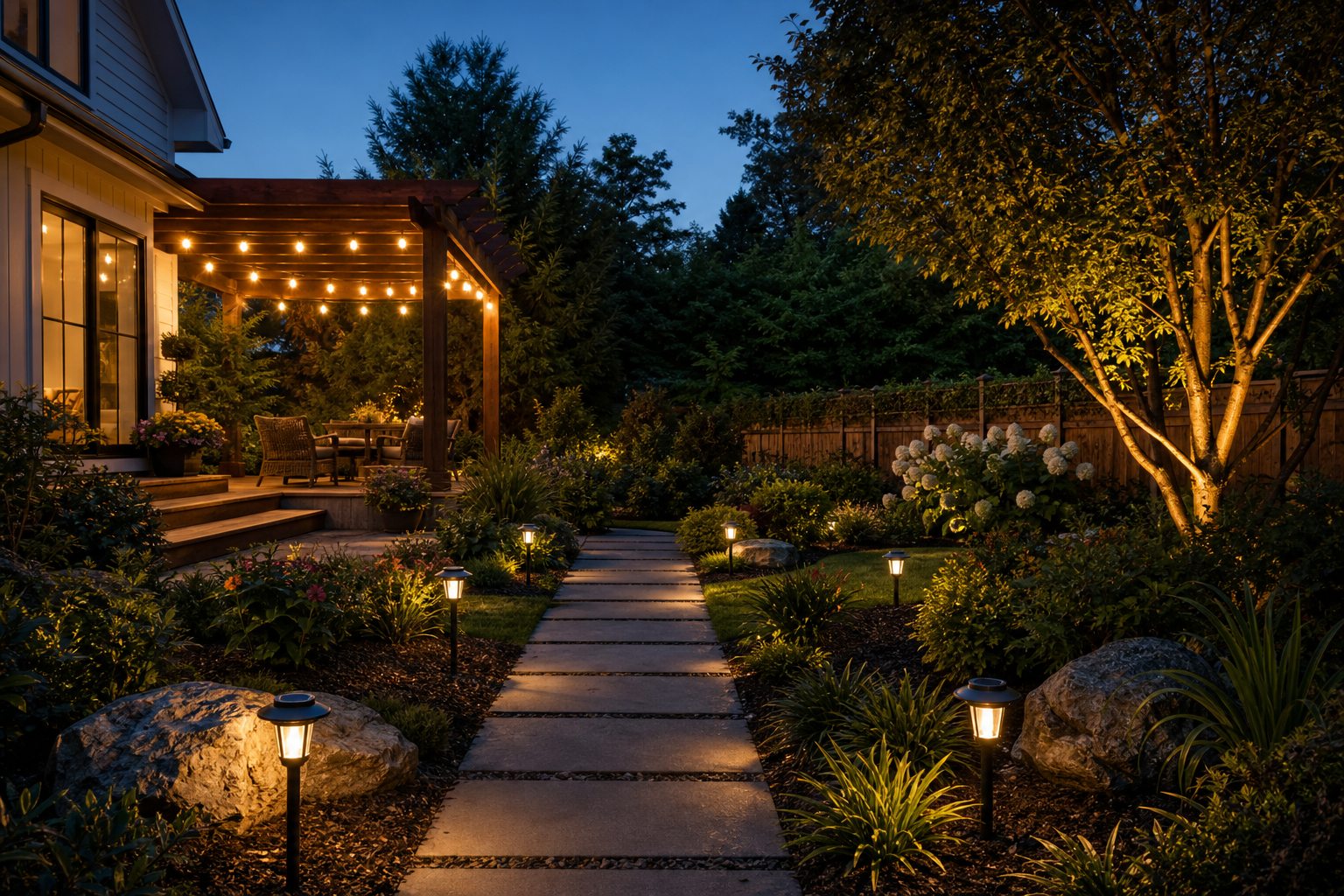
The best solar outdoor lighting plan starts with the job each light must perform, then matches that job to sun exposure, output, mounting position, weather protection, and battery capacity. Use pathway lights for navigation, spotlights for emphasis, motion lights for short bursts of security lighting, and decorative lights for ambience.
| Light type | Best use | Check before buying |
|---|---|---|
| Pathway lights | Walkways and garden edges | Stake height, spacing, glare |
| Spotlights | Trees, signs, walls | Panel placement and beam angle |
| Motion lights | Entrances and side yards | Detection range and mounting height |
| Decorative lights | Patios and landscaping | Effect, runtime, replacement battery |
Evidence note: This guide does not claim laboratory or firsthand test results. Product-specific specifications should be confirmed on the product page.
Quick answer: Solar outdoor lighting is self-contained lighting powered by sunlight — each fixture has a solar panel, a rechargeable battery, and a dusk-to-dawn sensor, so it charges by day and lights automatically at night with no wiring, no outlet, and no running cost. It’s ideal for paths, patios, fences, and gardens. Its one trade-off: it needs daily sun, so runtime is shorter in winter and in shade.
This is our complete hub for solar outdoor lighting — how it works, every type available, how to choose, install, and maintain it, and which lights suit which space. Each section links to a deeper guide.
How solar lights work
Every solar light contains four parts: a panel that collects sunlight, a rechargeable battery that stores it, a light sensor that detects dusk, and the LED itself. There’s no wiring because the fixture generates and stores its own power. Full explainer: how do solar lights work?
The types of solar outdoor lighting
Flame torches
Stake lights whose LEDs flicker like a real flame — no fire, fuel, or heat. Our solar flame torches stand 42.9″, are IP67 waterproof, and run up to 12 hours in summer. Guides: complete torch guide · vs. real tiki torches
String lights
The biggest single upgrade for a patio. Solar string lights with a remote come in 27–104 ft and run up to 10 hours. Guides: buyer’s guide · how to hang them
Path & landscape lights
Stake lights that mark walkways and borders. Browse solar landscape lighting and read the path & landscape buyer’s guide.
Post cap lights
Caps that sit on fence and deck posts. Ours fit standard 4x4 posts only (not 5x5/6x6). Guides: do they work & what fits · how to install
Spotlights
A focused, brighter beam for uplighting trees, walls, and flags. See the solar spotlights guide.
Motion & security lights
Motion-activated lighting for driveways, doors, and dark corners — the brightest solar category. See the motion & security guide or browse flood & security lights.
Lanterns
Hanging and tabletop glow for patios and campsites. See the solar lanterns guide.
House number signs
Illuminated address numbers so visitors, deliveries, and emergency services find you after dark. Ours are one digit per unit. Guides: how they work · why they matter
Garden décor
Beyond lighting: a solar water fountain (guide) and solar wind chimes add movement and sound to a garden.
Is solar right for your project?
Solar wins on cost, speed, and freedom from wiring; wired low-voltage wins on raw brightness and all-weather consistency. Read are solar lights worth it? and solar vs. low-voltage landscape lighting.
| Choose solar when… | Choose wired when… |
|---|---|
| There’s no outlet nearby | You need bright, guaranteed light nightly |
| You want DIY, today, no trenching | You want a designed, permanent system |
| You rent or want flexibility | The area is deeply shaded |
| It’s accent, path, or ambiance light | It’s security-critical lighting |
Choosing & placing it
- Sun is the whole game. Aim for 6+ hours of direct sun on the panel — see do solar lights need direct sunlight?
- The panel needs the sun, not the bulb. On string lights, the bulbs can hang in shade if the panel sits in sun.
- Check the weather rating. IP65 vs IP67 explained.
- Shady yard? It’s the hardest case — read best solar lights for a shady yard.
Care & troubleshooting
Solar lights need almost nothing, but three habits cover everything: keep the panel clean, keep it in sun, and expect shorter winter runtime.
- Why are my solar lights not working? — the universal fixes
- How to charge solar lights (first time, no sun, winter)
- How to make solar lights last longer & brighter
- Torch troubleshooting · fountain troubleshooting
Best solar lights by space
- Backyard · Patio · Driveway · Front yard
- Fence · Deck · Trees · Pool area
- Renters · RV & camping · Winter · Weddings & parties
Frequently asked questions
What is solar outdoor lighting?
It’s lighting powered entirely by sunlight. Each fixture has its own solar panel, rechargeable battery, and dusk-to-dawn sensor, so it charges during the day and switches on automatically at night with no wiring, no outlet, and no electricity cost.
How long do solar lights stay on at night?
It depends on the light and the sun it received. Our flame torches run up to 12 hours in summer and about 5 in winter, and our string lights up to 10 hours on a full charge. Runtime is always shorter after cloudy days or in shade.
Do solar lights work in winter?
Yes, but for fewer hours, because winter days are shorter and the sun is weaker, so the panel collects less energy. Put panels where they get direct midday sun and keep them clear of snow and leaves to get the most out of them.
Are solar lights bright enough for security?
Decorative solar lights like torches and path lights are ambient rather than bright. For security-level light, use a solar motion sensor light, which produces far more output and only runs when it detects movement.
Do solar lights need any maintenance?
Very little. Wipe the panel clean when it looks dusty, keep it unobstructed and in direct sun, and check the stake or mount after storms. The rechargeable battery is the one wear part and may need replacing after a couple of years of daily use.
More guides
Specifications are current as of publication and may change. See product pages for details.
Sources and editorial methodology
- U.S. Department of Energy: How Does Solar Work?
- U.S. Department of Energy: Solar Radiation Basics
- DarkSky International: Five Principles for Responsible Outdoor Lighting
Editorial policy: This guide distinguishes established technical principles and documented specifications from firsthand testing. Product-specific performance depends on the item and real installation conditions.